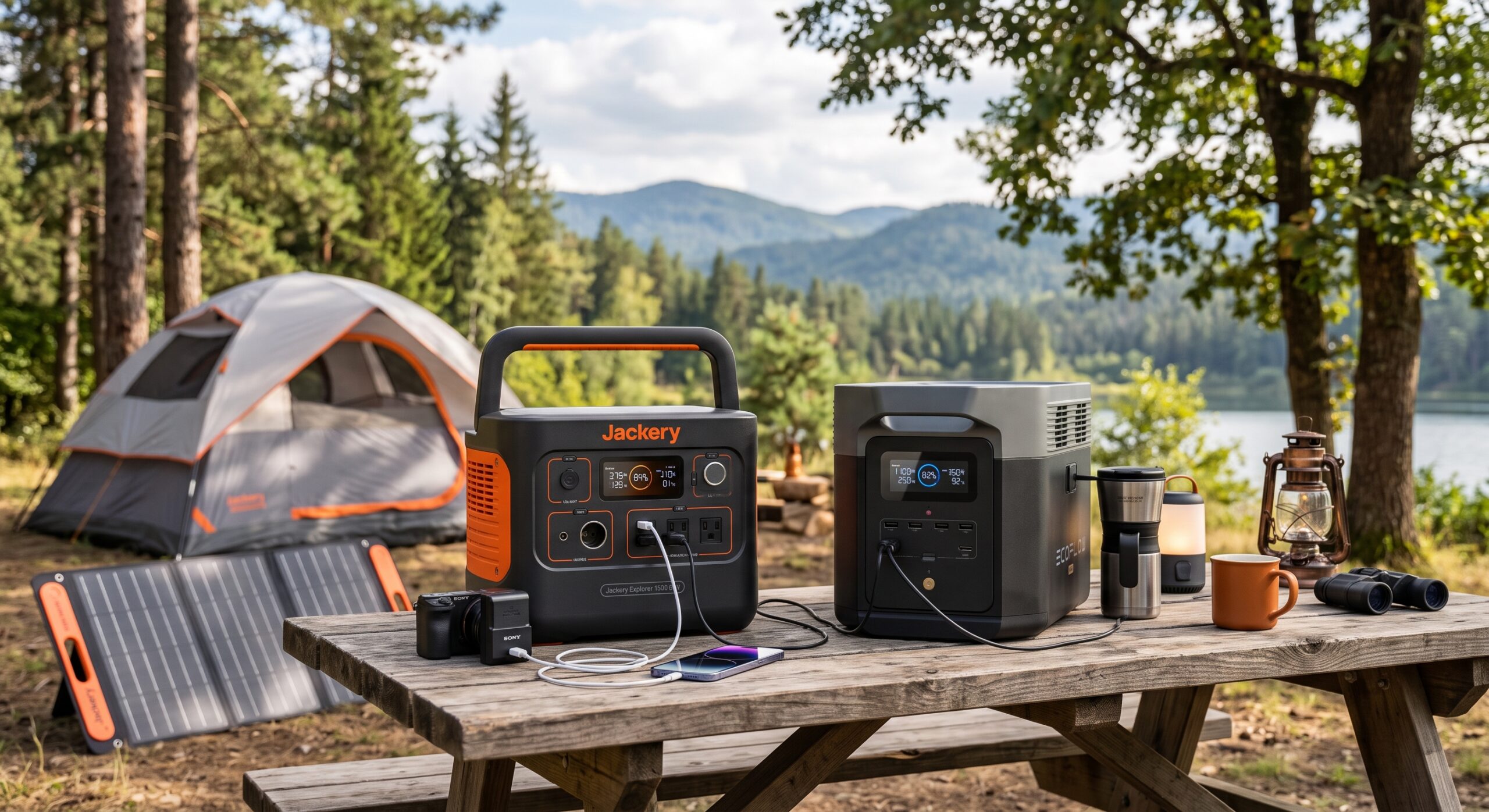
Jackery and EcoFlow are two of the most established names in portable power stations, and both make solid products across most capacity ranges but they differ in a few meaningful ways that matter depending on your priorities.
The portable power market has shifted from basic leisure accessories to critical infrastructure for off-grid living, overlanding, and home emergency preparedness. Choosing the right system is no longer just about selecting a battery size; it comes down to charging architecture, software intelligence, modular expandability, and long-term durability.
While both brands dominate reviews and best-seller lists, they approach portable power with distinct design philosophies. One leans into rugged simplicity and accessible, plug-and-play hardware, while the other prioritizes cutting-edge charging speeds, advanced home integration, and comprehensive digital control.
Quick Comparison
| Factor PDF | Jackery PDF | EcoFlow PDF |
| Charging speed | Good, generally slower than EcoFlow | Often faster, especially on larger units |
| App/smart features | Solid, straightforward | Generally more advanced, more integrations |
| Price | Competitive, often slightly lower | Slightly higher on comparable capacity |
| Build reputation | Very consistent, well-regarded reliability | Strong reliability, slightly more feature-forward |
| Expandability | Limited on most models | Strong expandable options on Delta Pro/Pro Ultra lines |
Core Engineering Differences
To understand how these power stations perform in daily use, it helps to examine the underlying hardware that powers them.
Battery Chemistry and Lifecycle
The modern standard across both brands is Lithium Iron Phosphate (LiFePO4, or LFP), which replaces older Nickel Cobalt Manganese (NCM) chemistry:
- LiFePO4 Lifespan: Up to 3,000 to 4,000 full charge cycles before dropping to 80% original capacity.
- Thermal Stability: Significantly reduced risk of thermal runaway, making LFP safer for indoor home backup and enclosed vehicle storage.
- Real-World Longevity: Under daily use, an LFP battery can operate reliably for nearly a decade before showing substantial degradation.
While EcoFlow transitioned almost their entire catalog to LFP early on (including the River 2 and Delta 2 series), Jackery followed suit with their “Plus” and “v2” iterations. Always ensure the specific model you choose uses LFP cells if maximum lifespan is your priority.
Where Jackery Tends to Win
Jackery’s lineup is known for straightforward reliability fewer bells and whistles, but consistent performance across their range, and often a slightly lower price for comparable capacity. Their Explorer series is a common recommendation for first-time buyers specifically because there’s less to go wrong and less to learn.
Key Strengths of Jackery
- Zero Learning Curve: Intuitive physical interfaces with clear, dedicated push buttons for AC, DC, and USB ports. You never need to consult a manual or connect to Wi-Fi just to turn on an outlet.
- Durable, Compact Chassis: Built with impact-resistant polycarbonate casings and integrated carry handles, making them exceptionally easy to pack in a car trunk or gear box.
- Quiet Operation: Conservative thermal management and efficient fan curves mean Jackery units run noticeably quieter under moderate loads compared to high-output competitors.
- Accessible Pricing: Frequently bundled with matched solar panels at promotional discounts, providing strong value for buyers seeking an all-in-one package.
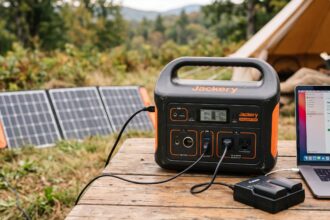
Jackery eliminates software clutter. For outdoor enthusiasts who simply want a battery to run a 12V camping fridge, recharge camera batteries, and illuminate a campsite without troubleshooting wireless settings, Jackery provides dependable simplicity.
Where EcoFlow Tends to Win
EcoFlow generally offers faster recharge speeds, especially notable on their larger Delta series units, along with a more feature-rich app experience and stronger expandability options for scaling capacity over time (particularly the Delta Pro and Pro Ultra lines, which support substantial add-on battery capacity).
Key Strengths of EcoFlow
- Industry-Leading AC Charging: Proprietary bidirectional inverter technology allows direct wall connection without bulky external power adapters, refilling from 0% to 80% in under an hour on many models.
- High-Yield Solar Controllers: Advanced internal MPPT algorithms process wide voltage windows, enabling high-wattage solar input even under fluctuating light conditions.
- Comprehensive Mobile App: Offers granular control over charging speed, discharge limits, port timers, and remote firmware upgrades via Bluetooth and Wi-Fi.
- Modular Ecosystem: Dedicated expansion ports allow users to double or triple storage capacity with plug-and-play extra batteries, scaling from weekend use to whole-house emergency power.
EcoFlow functions more like a smart energy hub. If you need to top off a large battery bank during a brief stop at an RV park, or want to automate a home backup transfer switch, EcoFlow delivers superior technical capability.
Feature Comparison Matrix
| Feature Focus | Jackery Approach | EcoFlow Approach |
| Grid Charging Architecture | Dedicated external brick on older units; integrated fast AC on newer Plus series. | Fully integrated bi-directional inverter across all Delta/River units. |
| Digital App Control | Clean, minimalist interface focused on basic input/output telemetry. | Deep customization: charge rate throttling, standby timers, smart automation. |
| Solar Input Flexibility | Optimized for proprietary DC connectors and matched SolarSaga panels. | Broad compatibility with universal MC4 and high-voltage third-party arrays. |
| Surge Handling | Solid rated surge capacity suitable for standard camp electronics and tools. | Enhanced surge multipliers (X-Boost) capable of running high-draw heating loads. |
| Form Factor & Portability | Fixed, sturdy molded carry handles; highly integrated shells. | Recessed handles; integrated rolling wheels and luggage handles on large units. |
Which Should You Choose?
- Choose Jackery if: you want a straightforward, reliable unit without needing advanced app features or maximum charging speed, and value a slightly lower price point.
- Choose EcoFlow if: fast recharge time matters to you, you want more expandability for future capacity growth, or you value a more feature-rich app experience.
Evaluating Buyer Profiles
The Weekend Camper and Overlander
- Recommended Brand: Jackery
- Why: Rugged, self-contained units that withstand trail dust, require no wireless setup, and provide straightforward reliability for 2–4 day outdoor trips.
The Full-Time RV and Van Life Traveler
- Recommended Brand: EcoFlow
- Why: Fast charging via shore power or high-wattage solar arrays minimizes downtime. The mobile app makes it easy to monitor energy consumption from anywhere inside the vehicle.
The Emergency Home Backup Planner
- Recommended Brand: EcoFlow
- Why: The ability to expand storage using secondary battery packs and tie directly into residential transfer switches gives EcoFlow a decisive advantage for severe weather preparedness.
The Budget-Conscious First-Time Buyer
- Recommended Brand: Jackery
- Why: Straightforward, competitively priced starter bundles that avoid confusing technical options, allowing you to learn your daily watt-hour consumption without friction.
Practical Buying Tips
- Calculate Continuous and Surge Demands: Identify the running wattage of your appliances and verify their startup surge. Refrigerators, air conditioners, and power tools require high initial current that must fall within the station’s surge rating.
- Match Solar Wattage to Battery Size: A 1,000Wh power station paired with only 100W of solar will require nearly two full days of clear sun to recharge. Aim for at least 200W to 300W of solar per 1,000Wh of capacity.
- Account for Ambient Temperatures: Both brands incorporate battery management systems that throttle charging speeds below 0°C (32°F) or above 45°C (113°F) to prevent cell degradation. Keep your power station in a climate-controlled space during extreme weather.
Bottom Line
Both brands make reliable, well-regarded power stations, and the choice often comes down to specific priorities rather than one brand being objectively better. Jackery suits buyers who want simplicity and reliability at a good price, while EcoFlow suits buyers who prioritize charging speed and future expandability.
By aligning your specific energy consumption, portability constraints, and need for smart-app control, either platform provides a durable, dependable foundation for off-grid power and home electrical backup.