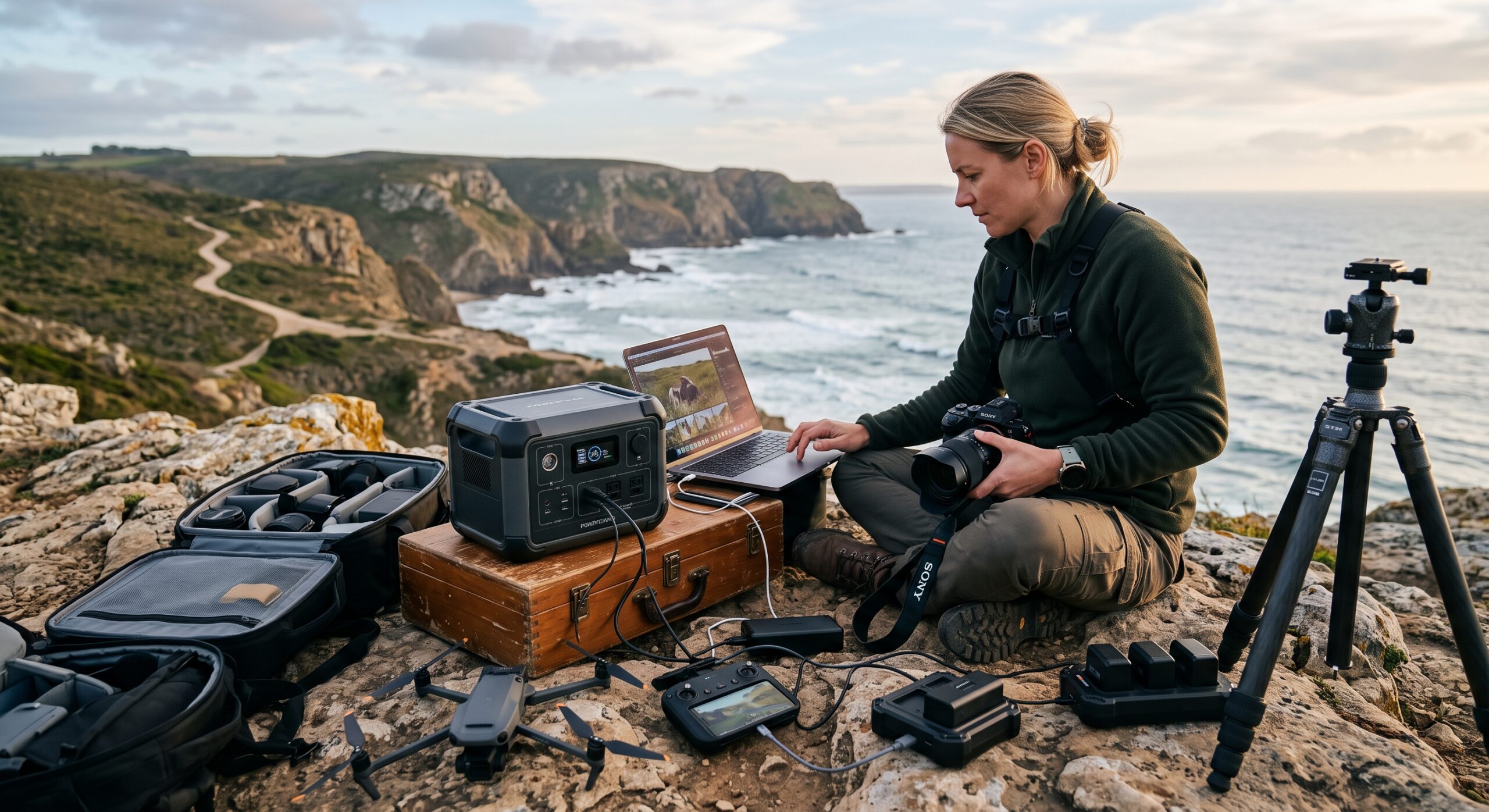
On-location shoots often mean no wall outlet for hours, making a portable power station essential for keeping camera batteries, laptops, and drone equipment charged throughout a long day of work.
In the fast-paced world of commercial photography, documentary filmmaking, and aerial drone mapping, mobility dictates success. Creative professionals consistently operate in remote environments—from windswept mountain ridges to abandoned industrial sites—where traditional grid power is completely nonexistent. Simultaneously, modern production workflows demand unprecedented amounts of electrical energy. High-resolution mirrorless bodies shoot data-heavy 4K and 8K video that can drain a standard internal battery in less than forty minutes. Enterprise drones require rapid, cyclical charging across multiple multi-cell flight packs to keep cameras in the air during the crucial golden-hour lighting window. Furthermore, on-site Digital Intermediate Technicians (DIT) must run power-hungry laptops to ingest footage, generate checksum backups, and verify exposure curves in real time.
Relying on a bag full of loose camera batteries is neither cost-effective nor sustainable for a full-day production shoot. Lithium flight packs are expensive, heavy, and sensitive to transport limits. Integrating a dedicated, modern portable power station transforms an on-location production from a stressful race against battery drain into an efficient, self-sustaining mobile studio.
Quick Comparison: Top Picks for Visual Content Creators
| Power Station Model | Battery Capacity | Continuous Inverter Rating | Primary Target Workflow | Standout Field Feature |
| Anker Solix C300 | ~288Wh | 300W | Solo Shooters, Hybrid Run-and-Gun Crews | Ultra-compact shoulder-strap form factor and dual fast USB-C PD |
| EcoFlow River 2 Pro | 768Wh | 800W | Small Video Crews, Multi-Drone Pilots | Rapid 70-minute AC wall recharge and high port density |
| Jackery Explorer 1000 v2 | 1,070Wh | 1,500W | Multi-Day Commercial Shoots, Remote Basecamps | High inverter headroom to run continuous LED video lights |
Typical Power Needs
Understanding your gear’s exact energy footprint prevents bringing an undersized battery to an intensive commercial shoot. Different creative tools place distinct demands on an electrical inverter:
- Camera battery chargers: 20-60W each Standard mirrorless camera batteries carry roughly 14Wh to 16Wh of energy each. Dedicated dual-bay camera battery chargers draw between 20W and 30W from a power station. Cinema cameras running heavy V-Mount or Gold Mount bricks demand dual chargers pulling up to 100W. Having native USB-C Power Delivery (PD) ports on your power station allows you to charge camera batteries directly inside modern camera bodies or via USB-C dual cradles, bypassing the need to run an AC inverter entirely.
- Laptop for on-site editing/backup: 30-65W On-site data management is non-negotiable. Transferring terabytes of RAW video footage forces laptop processors to run at peak capacity. While an idling laptop might draw only 15W, a workstation rendering video previews or running offload software will pull a continuous 60W to 100W through its USB-C port. A power station equipped with bidirectional USB-C PD allows your field workstation to ingest footage all day without draining its internal battery.
- Drone battery chargers: 60-100W per battery, often charging multiple in rotation Enterprise and consumer drones utilize 3S to 6S Intelligent Flight Batteries. A standard multi-battery charging hub charges packs sequentially or simultaneously, pulling significant wattage. For a pilot maintaining continuous flight rotations, a power station must supply a steady flow of electricity without overheating its internal electronics.
- Portable lighting equipment: varies widely, 50-500W depending on setup Monolight battery strobes use energy intermittently and draw modest wattage while recharging their capacitors. Continuous Chip-on-Board (COB) video lights, however, present a heavy resistive drain. Attempting to run a 300W or 600W key light on location requires a heavy-duty power station with substantial capacity and high continuous output.
Top Picks
Depending on your production scale and team size, different power stations excel in distinct filming scenarios:
1. Anker Solix C300 Best for Solo Shooters
Compact and light enough to carry easily, covering camera and drone battery charging for a full day of solo work.
For the independent creator, solo wedding filmmaker, or landscape photographer who must hike miles into the backcountry, physical weight is the critical constraint. The Anker Solix C300 addresses this challenge by delivering high energy density in an ultra-portable footprint. Weighing approximately 9 pounds, it fits seamlessly into a run-and-gun production workflow.
Despite its compact chassis, the C300 provides exceptional connectivity. It incorporates bidirectional USB-C Power Delivery ports capable of supplying high-wattage power directly to laptops and fast-charging camera battery cradles without requiring bulky AC wall bricks. Its underlying Lithium Iron Phosphate (LiFePO4) battery chemistry ensures the unit can be cycled daily for over 3,000 charge cycles. Utilizing Gallium Nitride (GaN) semiconductor architecture, the station generates minimal waste heat and operates with near-silent cooling fans—a major benefit when recording on-location audio.
2. EcoFlow River 2 Pro Best for Multi-Device Charging
Higher output supports charging multiple camera and drone batteries simultaneously, useful for teams or multi-drone operations.
When a shoot involves a multi-person crew, battery turnover accelerates dramatically. A single-port compact charger quickly causes a logistical bottleneck. The EcoFlow River 2 Pro solves this with an 800W pure sine wave inverter and a 768Wh LiFePO4 battery pack.
The standout feature is its multi-port output configuration paired with rapid turnaround times. Equipped with multiple AC wall outlets and high-amperage USB-C ports, it allows you to power a multi-drone charging bank, replenish two dual-camera docks, and run an on-site DIT monitor setup at the same time. If your crew has a brief 60-minute break between location moves, the River 2 Pro’s proprietary X-Stream charging technology recharges the battery from 0% to 100% in approximately 70 minutes using a standard wall outlet.
3. Jackery Explorer 1000 v2 Best for Extended Shoots
For multi-day location shoots without easy recharge access, the larger capacity provides meaningful buffer across longer sessions.
On commercial productions, documentary expeditions, or multi-day off-grid shoots, having a large power buffer is essential. The Jackery Explorer 1000 v2 delivers over 1,000 watt-hours of dependable storage paired with a robust 1,500W pure sine wave inverter.
This level of output fundamentally expands what you can deploy in the field. Beyond simply rotating flight batteries and keeping laptops powered, the Explorer 1000 v2 can run continuous high-output COB LED lighting fixtures, high-powered DIT grading monitors, and small smoke machines for atmospheric effects. Jackery’s signature rugged build quality resists trail dust, gear-case vibrations, and rough handling in equipment vans, ensuring your crew never misses a shot due to an electrical failure.
Field Best Practices
- Prioritize Direct USB-C Power Delivery: Avoid using standard 120V AC wall plug chargers for camera batteries and laptops. Converting DC battery power to AC and back to DC wastes 15% to 20% of your energy as heat. Use native DC USB-C ports to maximize field efficiency.
- Implement Drone Battery Rotations: Never pull a drone battery out of an aircraft and plug it immediately into a charger. High-speed flight creates internal heat; connecting a hot battery triggers thermal safety locks. Let flight packs rest in the shade for fifteen minutes before charging.
- Deploy High-Yield Mobile Solar: For multi-day productions, pairing your power station with a 100W or 200W folding solar array captures supplemental energy throughout the day, fully replacing the energy drawn by your drone charging bank.
Bottom Line
For most solo photographers and drone pilots, a compact unit like the Anker Solix C300 covers a full day of charging needs without adding significant gear weight, while teams or multi-day shoots benefit from the added capacity and output of larger units like the EcoFlow River 2 Pro or Jackery Explorer 1000 v2. By honestly auditing your equipment wattages and managing battery cooling cycles, you ensure that your production equipment stays powered and your creative momentum never stalls.