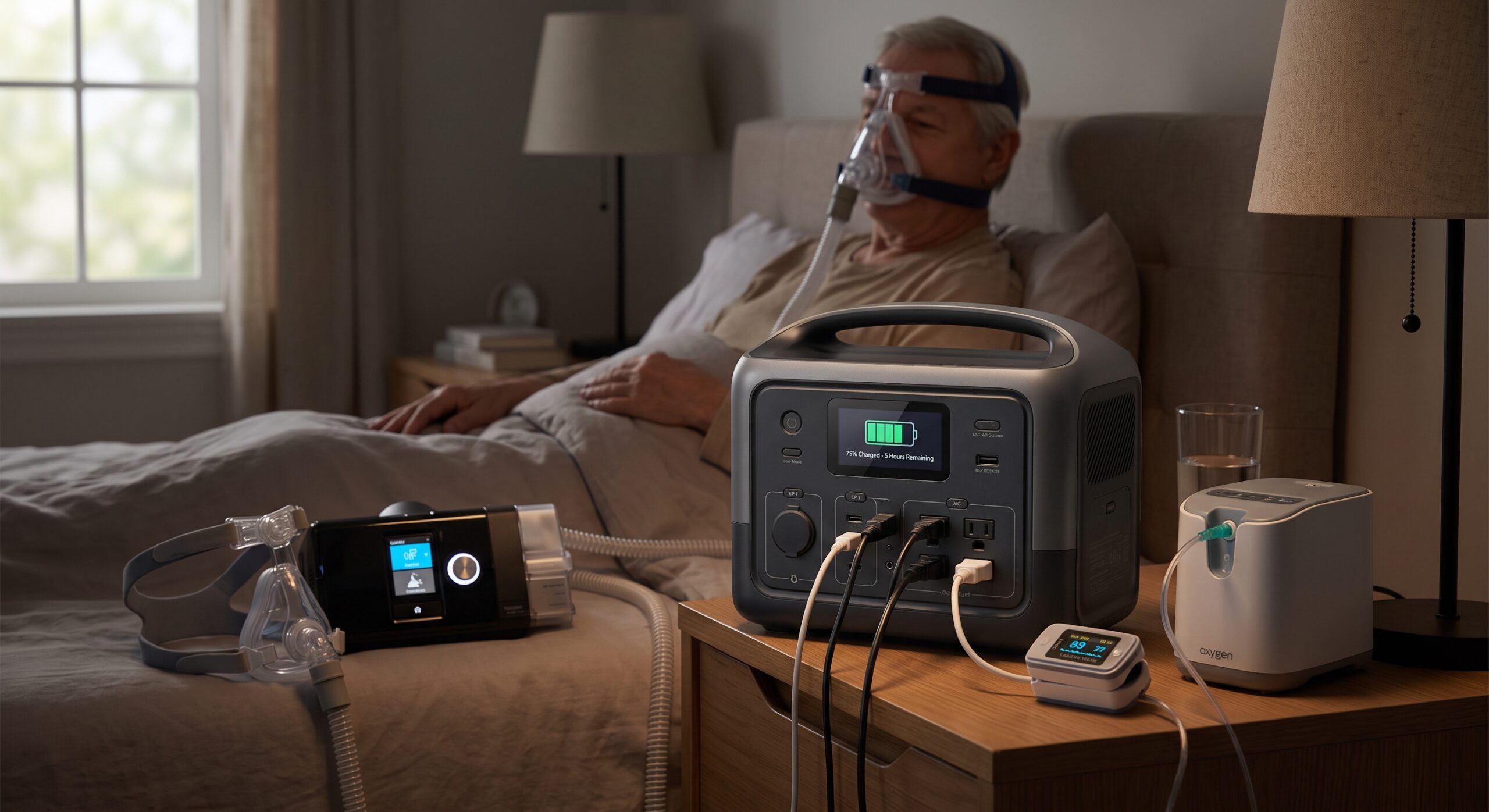
For households depending on medical equipment, a power outage carries real health risk, not just inconvenience. Choosing the right power station means understanding your specific equipment’s power needs and prioritizing reliability above all else.
When the electrical grid fails due to a severe winter storm, rolling blackout, or blown transformer, standard emergency prep usually revolves around preserving food or keeping the lights on. However, if you or a loved one relies on life-sustaining medical technology, grid failure instantly becomes a medical emergency. Traditional gas generators are often entirely unsuitable for this purpose; they must be operated outdoors due to toxic carbon monoxide exhaust, they are incredibly loud, and they require a constant supply of fresh gasoline that may not be available during a regional disaster.
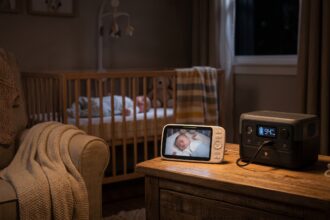
Portable, battery-powered solar generators solve these critical issues. They operate in complete silence, emit zero toxic fumes, and can be safely placed directly on a nightstand right next to a patient’s bed. But because medical hardware requires flawless, uninterrupted electrical stability, you cannot simply purchase the cheapest battery pack on the market. Sizing your system requires a clinical evaluation of your exact wattage demands.
Common Medical Equipment and Power Needs
To build a reliable failsafe, you must audit the continuous energy consumption of your specific devices. Below is a baseline overview of standard medical hardware demands:
| Equipment PDF | Typical Wattage PDF |
| CPAP/BIPAP machine | 30-90W |
| Oxygen concentrator | 300-600W |
| Nebulizer | 100-150W |
| Feeding pump | 20-50W |
| Motorized wheelchair charger | 100-300W |
Deep Dive: Analyzing Medical Power Demands
Understanding the why behind these wattage ranges is critical to surviving a multi-day outage.
- CPAP and BiPAP Therapy: The variance between 30W and 90W is almost entirely dependent on thermal comfort features. A CPAP machine pushing ambient air might only draw 20W to 30W. However, activating the heated hose and the heated water humidifier requires a resistive heating element, which instantly spikes consumption to 80W or 90W. In an emergency, turning off the humidifier will triple your battery’s runtime, allowing a moderate power station to safely cover three or four nights of sleep instead of just one. Furthermore, purchasing a dedicated 12V DC adapter for your specific CPAP brand eliminates the need to run the power station’s AC inverter, saving an additional 15% to 20% in electrical conversion losses.
- Oxygen Concentrators: These are among the most demanding pieces of in-home medical equipment. Because they rely on heavy internal mechanical compressors to scrub nitrogen from ambient air, they run continuously at high wattages (often 300W to 600W). More importantly, those compressors require a massive initial surge of electricity—sometimes up to 1,500W—just to start spinning. If your power station does not have a robust surge rating, the concentrator will fail to turn on.
- Motorized Wheelchairs: Wheelchair batteries are massive, meaning they demand sustained, high-amperage charging for several hours. A 300W charger will drain a compact 500Wh power station in less than 90 minutes. Users must invest in high-capacity systems if they expect to maintain mobility during an extended neighborhood blackout.
Top Picks
Selecting the correct model requires balancing physical portability against electrical endurance.
1. Jackery Explorer 1000 v2 Best Overall
Reliable output and enough capacity to run most single medical devices for a full day or more, from a brand with a strong reliability track record.
The Jackery Explorer 1000 v2 strikes an ideal balance for the vast majority of patients. Boasting an upgraded Lithium Iron Phosphate (LiFePO4) battery core, this unit is chemically stable, virtually eliminating fire risks while guaranteeing thousands of charge cycles. Its physical interface is intentionally uncluttered, featuring high-contrast physical buttons and a highly legible digital display. This design philosophy is incredibly beneficial for elderly users or those with visual impairments who may need to operate the unit in total darkness. Capable of outputting 1,500W continuously, it possesses the necessary overhead to comfortably absorb the startup surges of most respiratory machines without triggering safety faults.
2. EcoFlow Delta 2 Best for Multiple Devices
Higher capacity and output support running multiple medical devices simultaneously, such as an oxygen concentrator alongside a CPAP.
For patients requiring advanced, multi-device life support, the EcoFlow Delta 2 is a foundational workhorse. Its proprietary X-Stream charging technology allows the unit to recharge from a wall outlet from 0% to 80% in under 50 minutes. If the grid flickers on briefly during a severe storm, you can capture enough energy in an hour to survive the next full day. Additionally, the Delta 2 features expansion ports; you can purchase secondary battery packs to daisy-chain into the main unit, instantly doubling your medical reserve capacity without buying a whole new system.
3. Anker Solix C300 Best Compact Backup
For lighter needs (CPAP alone), a smaller, more portable unit provides sufficient runtime without unnecessary bulk.
Heavy-duty power stations weighing 30 to 50 pounds are not practical for travel or for resting on a small bedside table. The Anker Solix C300 fills the ultralight niche perfectly. Weighing less than 10 pounds, it is effortless to carry between rooms or pack into a vehicle for hotel stays. While its smaller battery cannot sustain high-draw oxygen machines, it is masterfully engineered for CPAP users who have disabled their heated humidifiers. Its whisper-quiet GaN (Gallium Nitride) architecture ensures that internal cooling fans will not disrupt your sleep.
Critical Consideration: Pure Sine Wave Output
Medical equipment, especially oxygen concentrators and some CPAP models, requires clean, pure sine wave power. Confirm this specification explicitly before purchasing nearly all reputable modern power stations provide it, but it’s worth verifying rather than assuming.
The electrical grid delivers Alternating Current (AC) in a smooth, rolling, continuous wave. Inexpensive, low-tier power banks often utilize a “Modified Sine Wave” inverter to save on manufacturing costs. A modified sine wave forces the electrical current into jagged, blocky, stair-step patterns.
When you plug sensitive microprocessors or inductive motors (like the compressor inside an oxygen machine) into a modified sine wave, the jagged electrical current causes the motor to run significantly hotter, vibrate aggressively, and emit a loud electrical hum. Over just a few hours, this dirty electricity can permanently burn out the internal motherboards of life-saving equipment. Never compromise on this specification; a verified Pure Sine Wave inverter is a mandatory, non-negotiable requirement for any medical application.
Emergency Power Supply (EPS) and Uninterrupted Sleep
A major vulnerability during grid failures is the unpredictability of the event. If a power line goes down at 3:00 AM, a patient relying on a CPAP or BiPAP machine will suddenly wake up struggling for air.
To mitigate this, patients should prioritize power stations featuring an Emergency Power Supply (EPS) or Uninterruptible Power Supply (UPS) function. Units equipped with EPS allow you to plug the power station directly into the wall outlet, and then plug your medical device directly into the power station. Under normal conditions, the electricity bypasses the battery entirely, running straight from the grid to your machine. The millisecond the grid fails, the power station’s internal sensors detect the voltage drop and automatically switch to battery power (typically in under 30 milliseconds). The transition is so rapid that the medical device never loses power, ensuring the patient continues sleeping safely without disruption.
Developing a Comprehensive Failsafe Routine
Securing the hardware is only the first phase of medical preparedness; maintaining operational readiness dictates your actual survival.
- Quarterly Calibration and Testing: Do not leave your power station sitting dormant in a closet for three years waiting for an emergency. Every three to four months, pull the unit out, plug your medical equipment into it, and sleep through the night using battery power. This confirms that the unit operates correctly, verifies your exact runtime calculations, and builds crucial muscle memory so you aren’t fumbling with cables during an actual blackout.
- Optimal Storage Parameters: Store your medical power station in a climate-controlled room. Keeping lithium batteries in a freezing garage or a blistering hot sunroom accelerates chemical degradation. Ensure the battery is maintained at approximately 60% to 80% state of charge during standby periods to prolong its multi-year lifespan.
- Solar Replenishment Strategies: If a hurricane or winter freeze knocks out municipal power for a week, battery capacity alone will eventually run out. Investing in a 100W or 200W portable folding solar panel allows you to replenish your power station during daylight hours, creating a truly infinite loop of medical security.
Bottom Line: For medical equipment backup, prioritize confirmed pure sine wave output and size capacity generously above minimum calculated need, given the seriousness of running out of power for essential equipment. The Jackery Explorer 1000 v2 offers dependable coverage for most single-device needs, while multi-device households should consider the added capacity of the EcoFlow Delta 2.
Treat your power station not just as a convenient camping accessory, but as an integral extension of your medical infrastructure. By rigorously auditing your watt-hour consumption, securing pure sine wave delivery, and implementing automated EPS switchovers, you construct an uncompromising barrier against the unpredictability of the modern electrical grid.