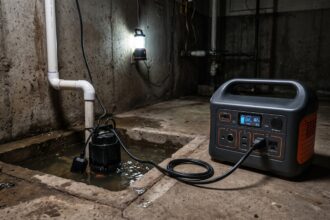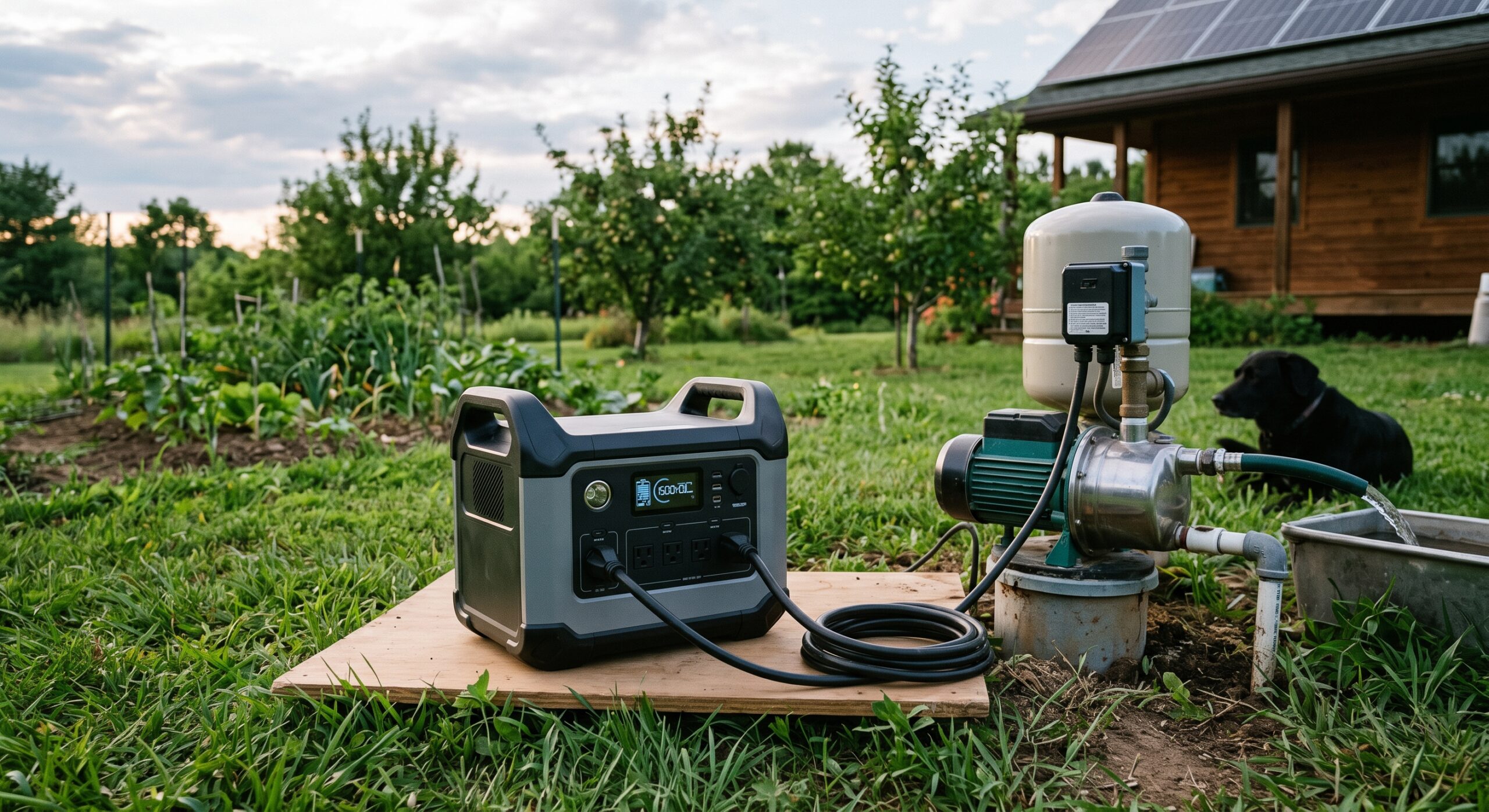
If your home relies on a private well, a power outage means more than losing lights and Wi-Fi — it means losing running water entirely, since well pumps depend on electricity to push water up from underground. This makes well pump backup one of the most urgent priorities for rural and off-grid households during an outage. The short answer is yes, portable power stations can work for well pumps, but with real limitations that are worth understanding before you rely on one.
The Short Answer
Portable power stations can run many residential well pumps, but well pumps are among the most demanding household appliances to back up with a battery system, due to very high startup surge and, in many cases, high running wattage. Smaller shallow-well pumps are realistic to power with a mid-size unit; deep-well and larger submersible pumps often require a high-output power station or may exceed what’s practical for battery backup altogether.
Why Well Pumps Are Especially Demanding
Two factors make well pumps harder to back up than most other appliances:
- Very high startup surge. Well pump motors need significant torque to start moving water from a standstill, especially in deep wells where the pump has to push water a long vertical distance. Surge wattage can be 3-5 times the running wattage.
- Higher running wattage than most household appliances. Depending on well depth and pump type, running wattage often falls in the 1,000-2,500W range — well above a refrigerator or CPAP machine, and closer to (or exceeding) what a space heater requires.
Well Pump Power Requirements by Type
| Pump Type | Typical Depth | Running Watts | Surge Watts |
|---|---|---|---|
| Shallow-well jet pump | Under 25 ft | 500-1,000W | 1,500-2,500W |
| Deep-well jet pump | 25-100 ft | 1,000-1,500W | 2,500-4,000W |
| Submersible pump (standard) | 100-300 ft | 1,000-2,000W | 3,000-5,000W |
| Submersible pump (deep) | 300+ ft | 1,500-2,500W+ | 4,000-6,000W+ |
These figures vary significantly by pump horsepower, well depth, and manufacturer, so checking the specific motor label or the well system’s documentation is the most reliable way to size a backup power source correctly.
Which Power Stations Can Realistically Handle a Well Pump?
Given these numbers, most entry-level and mid-range power stations (under 1,500W continuous output) will struggle to reliably start deep-well or submersible pumps, even if their capacity (Wh) looks generous. What matters most here is the surge and continuous output rating, not just total energy storage.
Power stations with a realistic chance of running common well pumps:
- High-output units (2,000W+ continuous, 4,000W+ surge) such as the EcoFlow Delta Pro or Bluetti AC500 series are the most likely to reliably start and run shallow-to-medium-depth well pumps.
- Mid-range units (1,800-2,400W continuous) like the EcoFlow Delta 2 Max or Bluetti AC200L can often handle shallow-well jet pumps and smaller submersible pumps, but may struggle with deep or high-horsepower systems.
- Entry-level units (under 1,500W continuous) are generally not sufficient for most well pumps and are better suited to lighter loads like refrigerators, lighting, and device charging.
How Long Can a Power Station Run a Well Pump?
Unlike a refrigerator that cycles gently, a well pump’s runtime depends heavily on household water usage patterns — it runs each time water pressure drops (a faucet turns on, a toilet flushes, a shower runs), not on a fixed schedule.
As a rough estimate: a 2,000Wh power station running a pump that draws 1,200W might sustain roughly 1.5-2 hours of actual pump-on time — but since a well pump typically only runs for a few minutes at a time when triggered by water use, this can translate into a full day or more of normal, conservative household water use (a handful of short pump cycles) rather than continuous operation.
Practical implication: a power station can often handle essential water needs (drinking, basic sanitation, occasional handwashing) during an outage, but sustained use — long showers, laundry, dishwashing — will drain capacity far faster than the numbers might initially suggest.
Tips for Backing Up a Well Pump with a Power Station
- Confirm your pump’s exact running and surge wattage from the motor label or manufacturer documentation before assuming any specific power station will work — this is not a place to guess based on general averages.
- Conserve water use during the outage. Limiting the pump’s on-cycles (shorter showers, fewer flushes, filling a container for drinking water rather than leaving a tap running) meaningfully extends how long your capacity lasts.
- Consider a smaller backup water source as a supplement, such as stored drinking water, so the well pump isn’t your only source of water during the outage — this reduces pressure to run it constantly.
- Pair with solar panels for extended outages, since well pump backup during a multi-day outage will likely require recharging the power station at least once.
- If your pump exceeds what a portable power station can handle, a dedicated generator (gas or propane) sized specifically for well pump backup is often the more practical long-term solution for rural or off-grid households.
When a Power Station Isn’t the Right Tool
For households with deep wells, high-horsepower pumps, or serious dependence on well water (a full household with multiple residents, livestock, or agricultural use), a portable power station may not be a realistic primary backup solution. In these cases:
- A whole-home or dedicated well-pump generator (typically propane or gas-powered, professionally installed) is built for exactly this kind of sustained, high-wattage demand.
- A power station can still serve as a secondary or emergency option — enough to get a few gallons of water during a short gap before a generator is available, or as a backup if the primary generator runs out of fuel.
Frequently Asked Questions
Can a Jackery or similar mid-range power station run my well pump? It depends entirely on your pump’s wattage. Many mid-range units can handle shallow-well or lower-horsepower pumps, but will struggle with deep-well or submersible pumps drawing over 1,500-2,000W continuously. Always check your specific pump’s rating first.
Why does my well pump work with a small generator but not a power station of similar wattage? Gas generators often have different surge-handling characteristics than battery inverters, and some pumps are more sensitive to the type of power waveform delivered. This is why checking a power station’s specific surge rating (not just assuming based on a generator comparison) matters.
Is it worth buying a bigger power station just for well pump backup? If well water is your only water source and outages are a regular occurrence in your area, yes — sizing up specifically for the pump’s surge and running wattage is worth the extra cost, since an undersized unit that fails to start the pump provides no backup at all.
Bottom Line
Portable power stations can work for well pumps, but only if their continuous and surge output ratings genuinely exceed what the specific pump demands — total battery capacity (Wh) alone isn’t the deciding factor. Shallow-well and lower-horsepower pumps are realistic to back up with a mid-to-high-output power station, while deep-well and submersible pumps often push toward the upper limits of what portable units can reliably handle, making a dedicated generator the more practical choice for households with serious, sustained well water dependence.