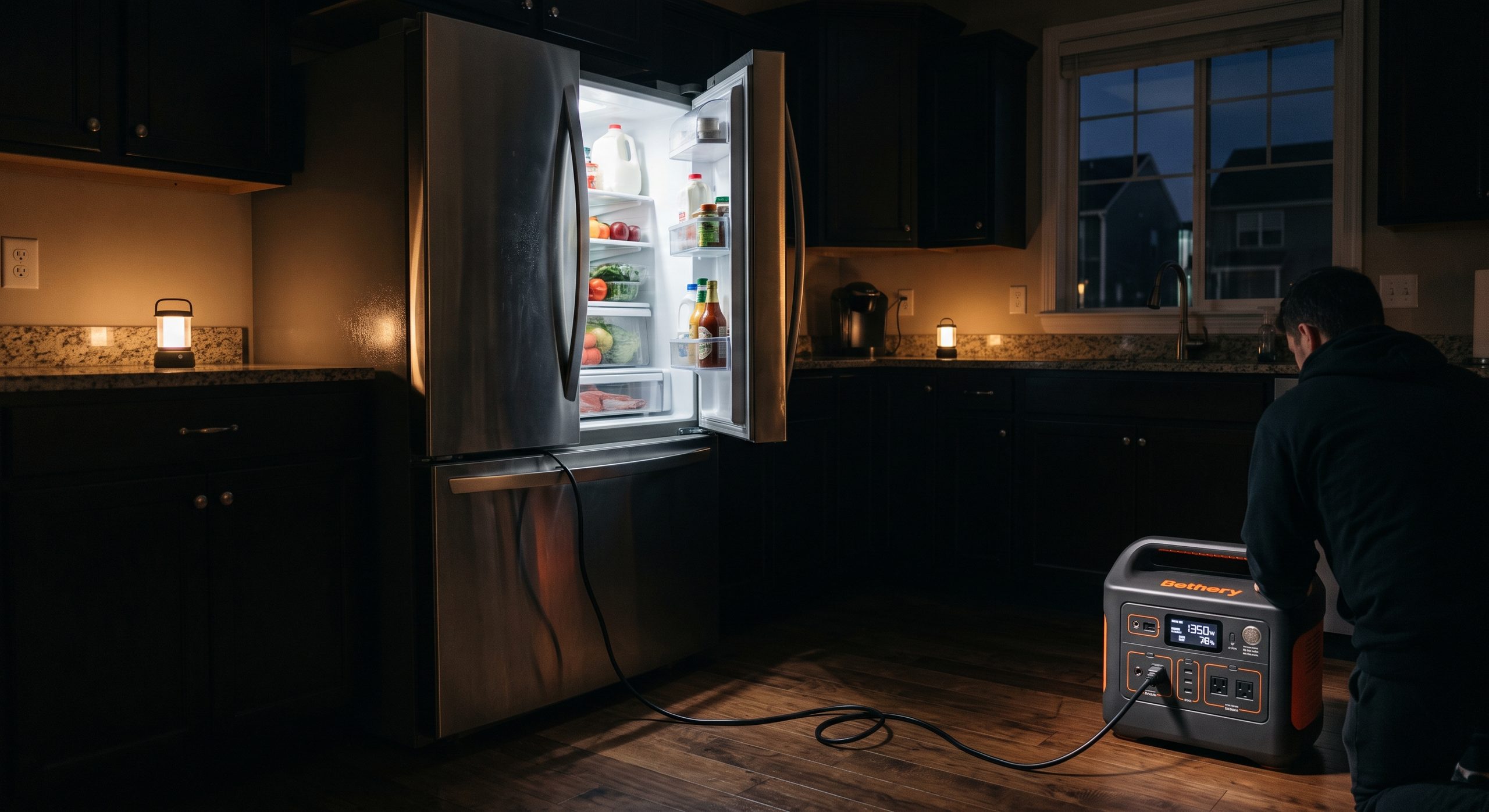
If the power goes out, the refrigerator is usually the first appliance people worry about — losing a full fridge of food is expensive and avoidable. But sizing a power station or generator for a refrigerator isn’t as simple as checking one number on the appliance. Here’s how to figure out exactly how many watts you need, and for how long.
The Short Answer
Most household refrigerators need 100-400 running watts, with a startup (surge) spike of 800-1,200 watts for a few seconds when the compressor kicks on. For most standard fridges, a power source rated for at least 300-600 continuous watts and 1,000+ surge watts is a safe baseline.
Running Watts vs. Surge Watts: Why Both Matter
Refrigerators don’t draw a constant amount of power. There are two numbers that matter:
- Running watts (continuous): The steady amount of power the fridge uses once the compressor is already running. Typically 100-400W for most home refrigerators.
- Surge watts (startup): A short spike — often 2-3x the running wattage — that happens for a second or two every time the compressor motor starts. This is the number that trips up underpowered generators and power stations.
If your power source can’t handle the surge, the fridge may fail to start even though it can easily handle the running load. This is why manufacturers list a separate «surge» or «peak» wattage rating on power stations and generators.
How to Find Your Refrigerator’s Actual Wattage
- Check the appliance label. Most refrigerators have a sticker inside the door or on the back listing voltage and amperage (e.g., «120V, 6A»).
- Convert amps to watts. Multiply volts by amps: 120V x 6A = 720W. Note that this is often the maximum rating, not the typical running wattage, so real-world draw is usually lower.
- Use a plug-in watt meter if you want an exact, real-world reading. These inexpensive devices (often under $20) show actual running and surge wattage as the fridge cycles on and off.
Wattage by Refrigerator Type (Approximate)
| Refrigerator Type | Running Watts | Surge Watts |
|---|---|---|
| Mini fridge / dorm fridge | 50-100W | 150-300W |
| Standard top-freezer fridge | 100-200W | 600-800W |
| Side-by-side fridge | 150-300W | 800-1,200W |
| French door fridge with ice maker | 200-400W | 1,000-1,300W |
| Chest freezer | 100-300W | 500-900W |
These figures vary by brand, age, and efficiency rating, so a watt meter reading is always more accurate than a general table.
How Long Will a Power Station Run a Refrigerator?
Once you know the running wattage, you can estimate runtime using the power station’s capacity (measured in watt-hours, Wh):
Estimated runtime (hours) = Power station capacity (Wh) ÷ Average fridge wattage
For example, a 1,000Wh power station running a fridge that averages 150W (accounting for the compressor cycling on and off, not running continuously) could realistically power that fridge for roughly 15-20 hours, since the compressor isn’t drawing power the entire time — it cycles on for a portion of each hour.
In practice, most fridges only run the compressor 30-40% of the time once the interior temperature is stable, which is why real-world runtime is often longer than a simple «capacity ÷ running watts» calculation would suggest.
Tips to Extend Runtime During an Outage
- Keep the door closed as much as possible. Every time it’s opened, the compressor has to work harder to recover the temperature.
- Keep the fridge full. A fuller fridge retains cold better than a mostly empty one, reducing how often the compressor needs to cycle on.
- Consider a chest freezer instead of an upright if food storage during outages is a recurring concern — chest freezers are generally more efficient and hold cold longer once unpowered.
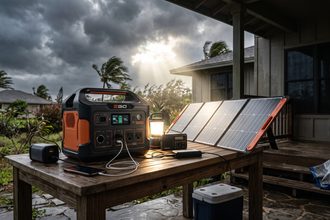
- Pair with solar panels if the outage is expected to last more than a day, so the power station can recharge during daylight hours instead of running down completely.
Bottom Line
For most standard refrigerators, a power source with at least 300-600 continuous watts and 1,000+ surge watts will keep it running reliably through an outage. If you’re shopping for a power station specifically for refrigerator backup, checking both the running and surge wattage — not just the «capacity» number — is the detail most buyers overlook, and the one most likely to cause a fridge to fail to start when it matters most.