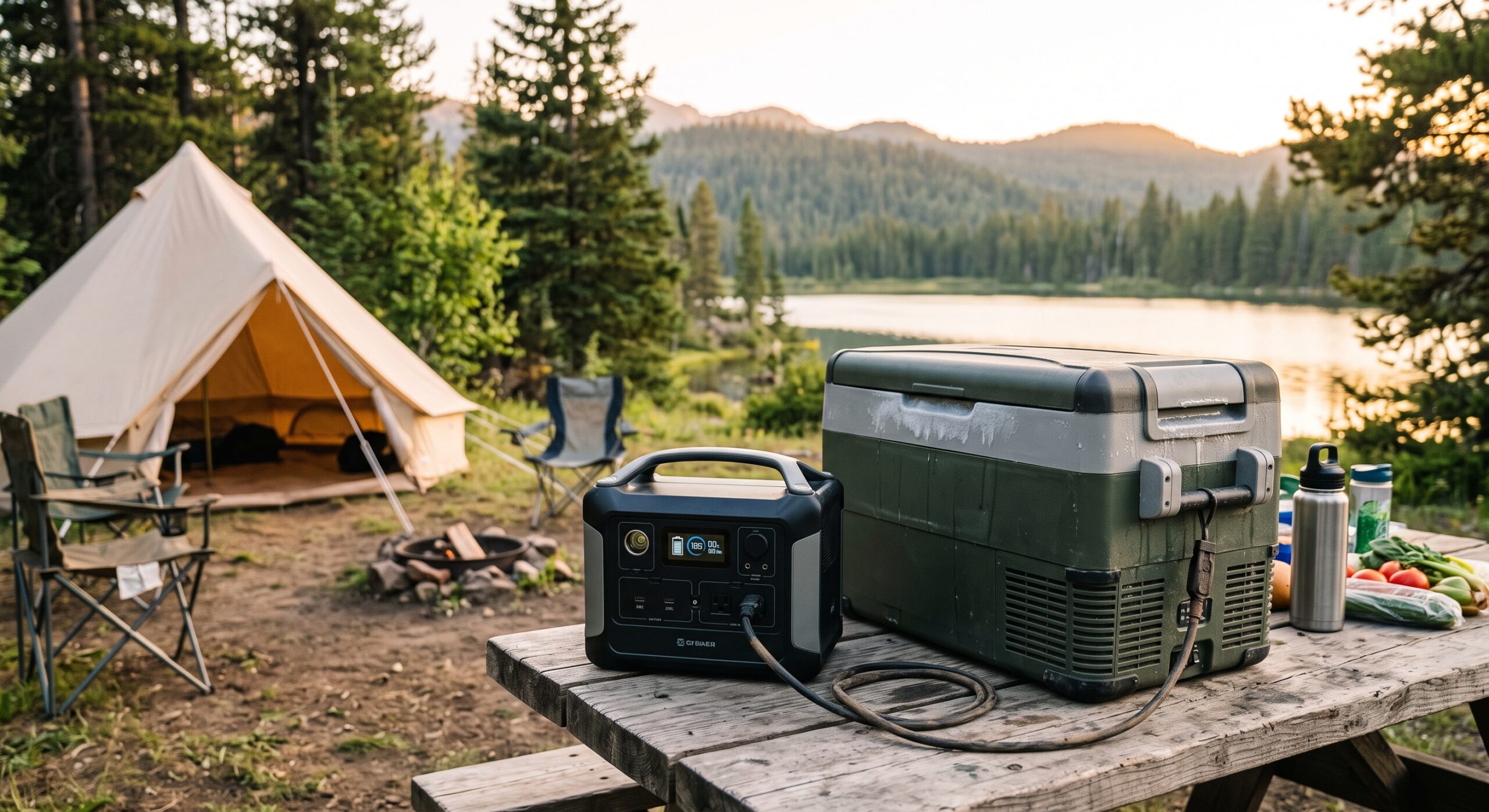
This is one of the most practical questions anyone planning an off-grid camping trip needs answered before they leave, not after their food starts warming up on day three. The honest answer is «it depends» — but it depends on a specific, calculable set of factors, and once you understand them, you can get a genuinely reliable estimate rather than a vague guess. This guide walks through exactly how to calculate runtime for your specific fridge and power station combination, plus the real-world variables that can shift that number significantly in either direction.
The Core Formula
At its simplest, runtime comes down to:
Estimated days = Power station capacity (Wh) ÷ Fridge’s average daily power use (Wh/day)
The tricky part isn’t the math — it’s getting an accurate number for «average daily power use,» since a fridge’s actual draw depends heavily on size, ambient temperature, and how often it’s opened. The rest of this guide focuses on nailing down that number.
Step 1: Know Your Fridge’s Real Daily Power Use
Campsite fridges (12V compressor fridges) don’t run continuously — the compressor cycles on and off to hold temperature. Manufacturer specs sometimes list «average daily consumption» directly, but if yours doesn’t, here’s a realistic breakdown by size and condition:
| Fridge Size | Mild Weather (60-75°F) | Warm Weather (75-90°F) | Hot Weather (90°F+) |
|---|---|---|---|
| Small (15-25L) | 150-250Wh/day | 250-350Wh/day | 350-500Wh/day |
| Medium (35-50L) | 250-350Wh/day | 350-500Wh/day | 500-700Wh/day |
| Large (50-75L) | 300-450Wh/day | 450-650Wh/day | 650-900Wh/day |
These ranges reflect the difference between a fridge sitting in the shade on a mild day versus one baking in direct sun on a hot afternoon — a difference that can nearly double power consumption for the exact same fridge and food load.
Step 2: Match This to Common Power Station Capacities
Once you have a realistic daily Wh figure for your fridge, here’s roughly how many days different power station capacities can sustain it, assuming no recharging in between:
| Power Station Capacity | Small Fridge, Mild Weather (~200Wh/day) | Medium Fridge, Warm Weather (~425Wh/day) | Large Fridge, Hot Weather (~775Wh/day) |
|---|---|---|---|
| 300Wh | ~1.5 days | ~0.7 days | ~0.4 days |
| 500Wh | ~2.5 days | ~1.2 days | ~0.6 days |
| 1,000Wh | ~5 days | ~2.4 days | ~1.3 days |
| 1,500Wh | ~7.5 days | ~3.5 days | ~1.9 days |
| 2,000Wh | ~10 days | ~4.7 days | ~2.6 days |
This table makes the impact of fridge size and weather conditions obvious: the same 1,000Wh power station might run a small fridge for five days in mild weather, or barely more than a day with a large fridge in the heat. This is why «how long will X power station run a fridge» doesn’t have one universal answer — it genuinely depends on your specific setup and conditions.
Step 3: Account for Other Loads Sharing the Battery
If you’re also charging phones, running lighting, or using other devices off the same power station, subtract that usage from your available capacity before calculating fridge runtime. A rough daily allowance for lighting and device charging on a typical trip is 50-150Wh/day, which should be deducted from the power station’s total capacity before running the fridge-only calculation above.
Factors That Extend Runtime
- Keeping the fridge in shade. Direct sun exposure can increase a fridge’s power draw by 30-50% compared to the same fridge kept shaded, simply because the compressor has to work harder against the extra heat.
- Minimizing lid openings. Every time the lid opens, cold air escapes and the compressor has to recover that lost temperature — frequent, brief check-ins are far less costly than long, thoughtful browsing with the lid open.
- Pre-chilling the fridge and contents before the trip. Starting cold (rather than asking the fridge to cool warm food from scratch) significantly reduces the initial compressor workload.
- Setting a slightly warmer target temperature (within food safety limits) reduces compressor run time meaningfully compared to running it at the coldest setting unnecessarily.
- Pairing with solar panels, which can offset some or all of the daily draw depending on sun conditions, effectively extending the trip length far beyond what the battery alone would support.
Factors That Shorten Runtime
- Hot weather and direct sun exposure, as covered above, are the single biggest variable — easily doubling power draw compared to a shaded, mild-weather setup.
- A poorly sealed or older fridge with worn gaskets will lose cold air more easily and run its compressor more often than a newer, well-sealed unit.
- Frequent restocking with warm items (ice, drinks, food brought from a warm car) forces the compressor to work overtime to bring the new items down to temperature.
- Sharing capacity with other devices, especially anything with meaningful draw like a fan, string lights left on overnight, or frequent laptop use.
Real-World Example Calculation
Say you’re bringing a medium 40L fridge on a 5-day trip in warm weather (around 80°F), plus modest phone charging and some lighting in the evenings.
- Fridge draw estimate: ~425Wh/day (medium fridge, warm weather)
- Other loads: ~100Wh/day (phone charging, evening lighting)
- Total daily draw: ~525Wh/day
- Trip length: 5 days = 2,625Wh needed total
This tells you a single 1,000Wh power station wouldn’t get you through the full trip without recharging, but a 1,500-2,000Wh unit would come close, and adding even a modest 100W solar panel (contributing roughly 300-350Wh on a sunny day) would comfortably close the gap.
Should You Rely on Solar to Extend Runtime?
Solar can meaningfully extend how long a fridge runs, but it shouldn’t be the only variable you plan around, since cloud cover, tree shade at a campsite, or simply forgetting to reposition panels through the day can all reduce actual solar input well below the «rated» wattage. A reasonable approach is to size your battery capacity to cover your trip length with a comfortable buffer (say, 80% of estimated need from battery alone), treating solar as a bonus that extends your margin rather than a guaranteed top-up you’re depending on.
Frequently Asked Questions
Does a fuller fridge use less power than an empty one? Generally yes — a fuller fridge (with food or even bottles of water) retains cold better between compressor cycles than a mostly empty one, reducing how often the compressor needs to run.
Is it better to buy one large power station or bring solar panels instead? For trips longer than about 4-5 days, solar panels usually offer better value than simply buying a much larger power station, since they provide ongoing recharge rather than a fixed, one-time capacity ceiling. For shorter trips, a larger battery alone is often simpler and just as effective.
Do power station specs (Wh capacity) account for real-world losses? Not entirely — expect to get roughly 85-90% of a power station’s rated capacity in real-world usable output, due to inverter efficiency losses when converting battery power to AC or 12V output. It’s worth building this small buffer into your calculations rather than assuming 100% of the rated Wh will be available.
Bottom Line
There’s no single answer to «how many days will my power station run a fridge» — it depends on fridge size, ambient temperature, how the fridge is used, and what else is sharing the battery. But by working through the daily Wh estimate for your specific fridge and conditions, then matching it against your power station’s real (not just rated) capacity, you can get a genuinely reliable planning number instead of an optimistic guess that runs out a day early. When in doubt, size your setup for the hot-weather, higher-draw end of the range rather than the mild-weather best case — running out of cold food on day three of a five-day trip is a far more frustrating outcome than having slightly more capacity than you strictly needed.