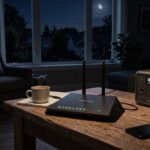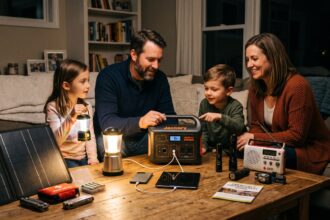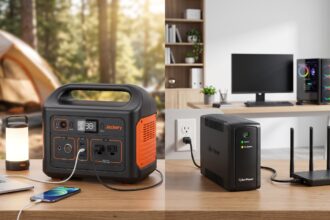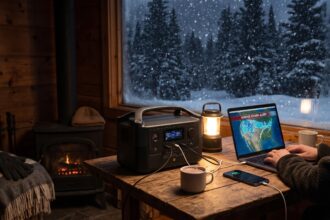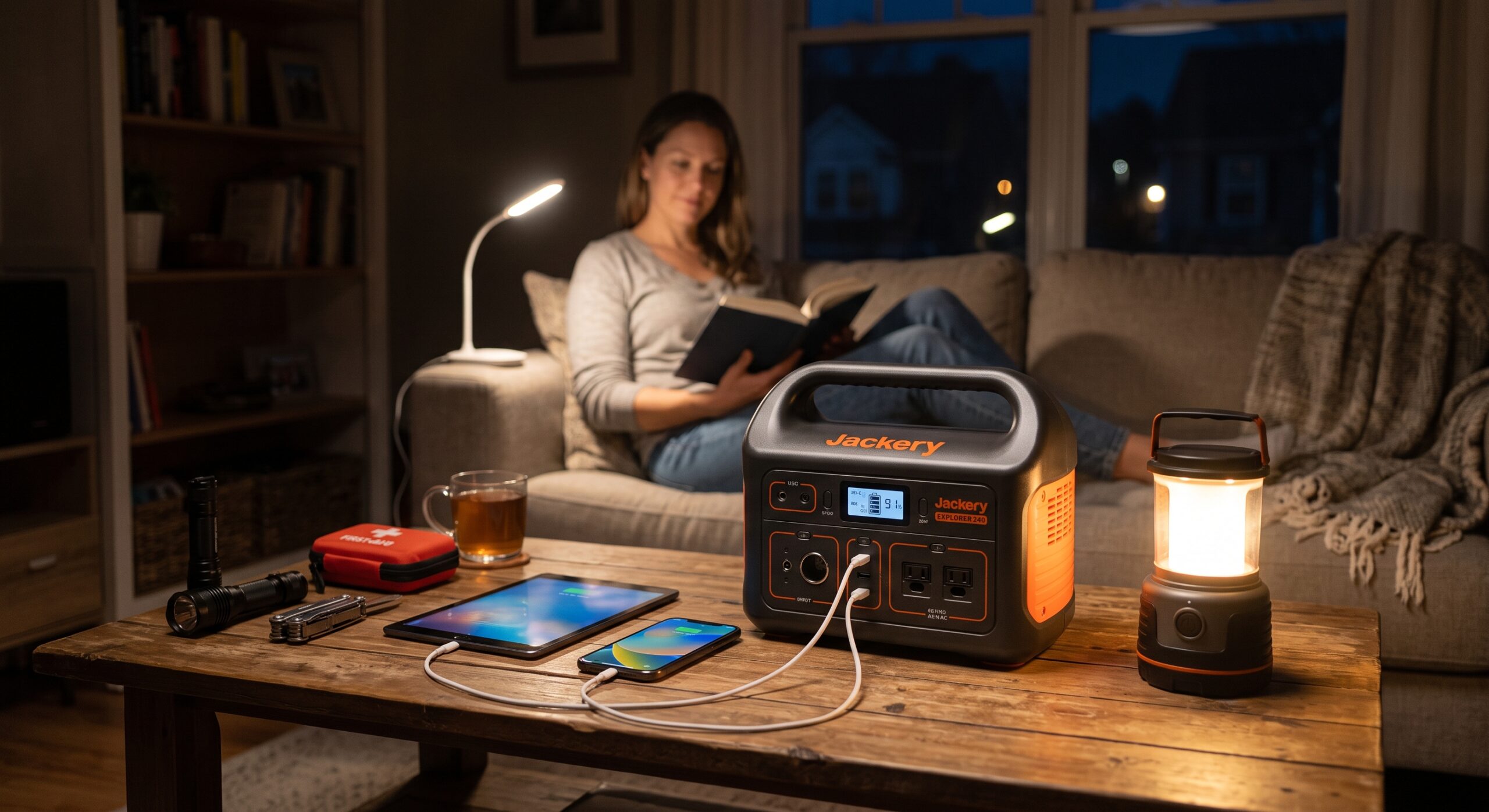
You don’t need to spend over a thousand dollars to build a solid emergency power setup. For most households, the real risk isn’t a week-long blackout — it’s a shorter outage of a few hours to a day or two, caused by a storm, a grid failure, or scheduled maintenance. For that kind of scenario, a power station under $500 can comfortably cover the essentials: lighting, phone and laptop charging, Wi-Fi, a CPAP machine, and even short stretches of refrigerator use. This guide breaks down the best options in this price range, what to realistically expect from them, and how to get the most value for your money.
Quick Answer: Our Top Picks
- Best Overall Under $500: Jackery Explorer 300 v2 — best all-around balance of capacity, output, and reliability
- Best for the Money: Anker Solix C300 — strong capacity-to-price ratio with a fast-charging design
- Most Compact: Bluetti EB3A — small enough for a closet shelf, still genuinely useful
- Best Output for the Price: EcoFlow River 2 — highest continuous wattage in this price tier
- Best for Expandability Later: Anker Solix C300 (works with optional solar panels if you want to grow the system)
What «Under $500» Realistically Gets You
In this price range, you’re typically looking at power stations in the 250-400Wh capacity range, with continuous output between 300-600W. That’s enough for:
- Charging phones, tablets, and laptops repeatedly (dozens of times per charge)
- Running a Wi-Fi router and modem for well over a day
- Powering LED lighting for multiple nights
- Running a CPAP machine (without a heated humidifier) for 1-2 nights
- Running a small fridge or mini fridge for several hours, or a full-size fridge for a few hours during short outages
What it generally won’t cover reliably: a full-size refrigerator for a full day, a sump pump, a window AC unit, or any appliance with a high startup surge. For those needs, you’d want to look at units above the $500 price point with 1,000Wh or more of capacity.
Top Power Stations Under $500
1. Jackery Explorer 300 v2 — Best Overall
At roughly 300Wh capacity and 300W continuous output (600W surge), the Explorer 300 v2 hits a practical sweet spot: enough capacity to matter during a real outage, without paying for headroom you won’t use. Jackery’s build quality and app support are consistently rated among the most reliable in this price tier, and recharge time from a wall outlet is under two hours — useful if you’re topping it off between uses rather than relying on it for a single long outage.
Best for: Households that want a dependable, no-surprises unit for short-to-medium outages.
2. Anker Solix C300 — Best Value
The Solix C300 offers around 288Wh of capacity with 300W continuous output, priced aggressively enough to undercut comparable competitors while matching them on build quality. It also supports Anker’s ecosystem of optional solar panels, so if your needs grow later, you’re not locked out of expanding the system.
Best for: Buyers who want the most capacity and features per dollar, with room to expand later.
3. Bluetti EB3A — Most Compact
At around 268Wh, the EB3A is one of the smallest and lightest units in this category, while still offering a surprisingly capable 600W continuous output (1,200W surge) — enough to briefly run higher-draw items that similarly sized competitors can’t handle. Its compact size makes it easy to store in a closet, car trunk, or even a backpack.
Best for: Small apartments, dorms, or anyone prioritizing storage space and portability over raw capacity.
4. EcoFlow River 2 — Best Output for the Price
The River 2 offers around 256Wh of capacity but stands out for its 300W continuous output with a strong surge rating, plus X-Boost technology that lets it run some higher-wattage devices (up to 600W) that would otherwise exceed its rated output. This makes it more flexible in practice than its capacity number alone suggests.
Best for: Buyers who want to occasionally push slightly higher-draw devices without upgrading to the next price tier.
5. Jackery Explorer 240 v2 — Best Ultra-Budget Pick
For those who want the absolute minimum viable emergency power setup, the Explorer 240 v2 sits at the lower end of this price range, offering around 240Wh of capacity — enough for phone charging, small lighting, and short CPAP use, but not much beyond that. It’s a reasonable starting point for someone building out an emergency kit gradually.
Best for: Tight budgets, or as a second/backup unit alongside a larger power station.
Comparison Table
| Model | Capacity | Continuous Output | Surge Output | Approx. Price |
|---|---|---|---|---|
| Jackery Explorer 300 v2 | ~300Wh | 300W | 600W | ~$280-320 |
| Anker Solix C300 | ~288Wh | 300W | 600W | ~$220-260 |
| Bluetti EB3A | ~268Wh | 600W | 1,200W | ~$230-270 |
| EcoFlow River 2 | ~256Wh | 300W (X-Boost to 600W) | 600W | ~$200-240 |
| Jackery Explorer 240 v2 | ~240Wh | 300W | 400W | ~$180-210 |
Prices fluctuate frequently with sales, especially around hurricane season and Black Friday, so it’s worth comparing current pricing before buying.
What to Prioritize at This Price Point
- Battery chemistry (LiFePO4 preferred): Many budget units now use LiFePO4 batteries, which last significantly longer (2,000-3,000+ charge cycles) than older lithium-ion chemistries, and are safer for long-term storage without degrading quickly.
- Recharge speed: In this price range, recharge time varies a lot — some units fully recharge from a wall outlet in under 2 hours, others take 4-5. If you plan to top off the unit between short outages rather than relying on a single long charge, this matters more than the spec sheet might suggest.
- Number and type of ports: Look for a mix of AC outlets, USB-A, USB-C (ideally with fast charging/PD support), and a 12V car-style port, since emergency use often means charging several different devices at once.
- Weight and portability: Most units in this range weigh 6-11 lbs, light enough to move between rooms or grab quickly if you need to evacuate.
- App/monitoring support: Not essential, but a companion app that shows remaining charge and estimated runtime makes it much easier to plan around a multi-hour or multi-day outage.
How to Build a Complete Emergency Kit Around a Budget Power Station
A power station under $500 works best as one part of a broader, low-cost emergency setup:
- Pair it with a small solar panel (60-100W) if you want to stretch a short outage into an indefinite one, recharging gradually during daylight hours.
- Keep a manual list of what to power first — phones, medical devices, and lighting should take priority over convenience items like fans or entertainment devices.
- Fully charge it at the start of storm season, and recharge it every few months even without an outage, since batteries slowly self-discharge over time.
- Add a second unit rather than upgrading to one larger unit, if your budget allows — two 300Wh units offer redundancy (one can be lent out, taken in a car, or used while the other charges) that a single larger unit doesn’t.
Frequently Asked Questions
Can a power station under $500 run a refrigerator? For a few hours, yes — most units in this range can keep a standard refrigerator running for 3-6 hours, which is enough to get through a typical daytime outage. For overnight or multi-day refrigerator backup, a larger unit (1,000Wh+) is a better fit.
Is it worth waiting for a sale instead of buying now? Prices in this category fluctuate regularly, with the deepest discounts typically appearing before hurricane season (May-June) and around Black Friday/Cyber Monday. If there’s no immediate need, waiting for one of these windows can save 15-30% on the same unit.
Should I buy one large unit or two smaller ones for under $500 total? Two smaller units offer more flexibility — one can stay at home while the other travels, or one can be actively recharging while the other is in use — but a single larger unit is simpler to manage and typically offers slightly better value per watt-hour.
Bottom Line
For emergency preparedness on a budget, the Jackery Explorer 300 v2 offers the most balanced, dependable option under $500, while the Anker Solix C300 edges it out on pure value if price is the deciding factor. Buyers who need every dollar to count should consider the Bluetti EB3A for its unusually strong output relative to its size, or start with the budget-friendly Explorer 240 v2 and add a second unit later as their emergency kit grows.