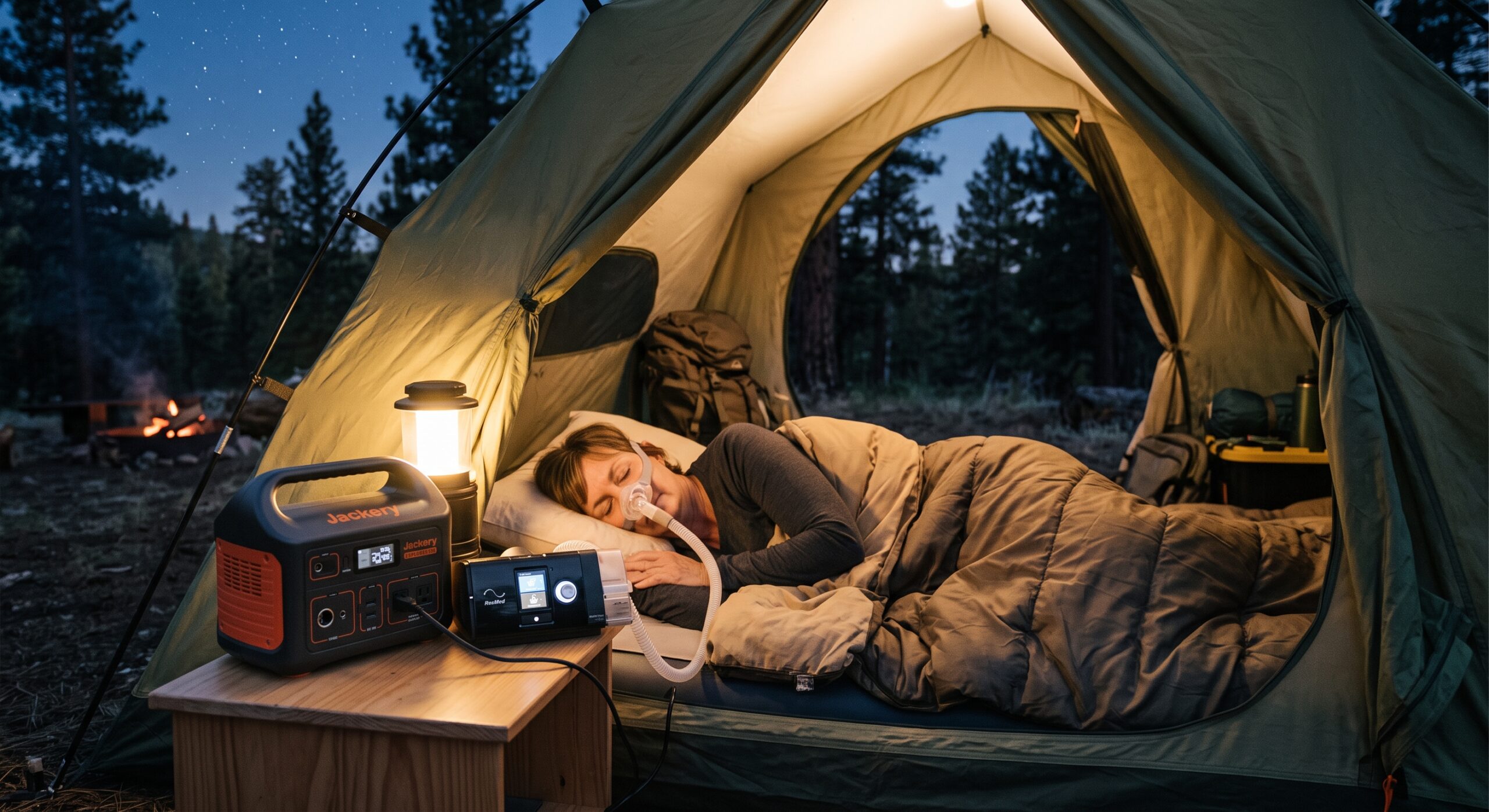
For anyone who depends on a CPAP machine to sleep safely, a power outage isn’t just an inconvenience — it can mean a night without treatment for sleep apnea. Fortunately, CPAP machines are relatively low-power devices, which makes them one of the easiest things to keep running with a portable power station. Here’s exactly how long you can expect one to last.
The Short Answer
Most CPAP machines draw 30-60 watts without a heated humidifier, or 60-90 watts with the humidifier running. A small 300Wh power station can typically run a standard CPAP for 1-2 full nights, while a 1,000Wh unit can often last 5-10 nights, depending on settings and humidifier use.
Why CPAP Power Draw Varies
CPAP power consumption depends on a few factors:
- Pressure setting: Higher prescribed pressures require slightly more energy to maintain airflow.
- Humidifier use: A heated humidifier can roughly double power draw, since heating water takes significantly more energy than running the motor alone.
- Machine model: Older machines and travel CPAPs draw less power than full-size machines with advanced humidification and heated tubing.
Estimated Runtime by Power Station Capacity
| Power Station Capacity | CPAP Only (~40W avg) | CPAP + Humidifier (~70W avg) |
|---|---|---|
| 300Wh | ~7 hours (1 night) | ~4 hours |
| 500Wh | ~12 hours (1-2 nights) | ~7 hours |
| 1,000Wh | ~25 hours (3-4 nights) | ~14 hours (2 nights) |
| 1,500Wh | ~37 hours (5+ nights) | ~21 hours (3 nights) |
| 2,000Wh | ~50 hours (7+ nights) | ~28 hours (4 nights) |
These are estimates based on average draw over a typical 7-8 hour sleep session; actual runtime will vary slightly by machine model and settings.
How to Check Your CPAP’s Exact Power Draw
- Check the power supply label, usually printed on the AC adapter brick — it typically lists voltage and amperage (e.g., «24V, 3.75A» = 90W maximum).
- Check your machine’s manual or manufacturer website, which often lists typical and maximum wattage separately.
- Use a plug-in watt meter for the most accurate real-world reading, especially if you use a humidifier or heated tubing.
Tips to Maximize CPAP Runtime During an Outage
- Turn off the heated humidifier if water supply is limited or you want to stretch battery life — the machine will still function for therapy, just with drier air.
- Lower the humidifier heat setting instead of turning it off completely, if comfort is a concern but battery life still matters.
- Fully charge the power station before a known outage risk, such as an incoming storm, rather than waiting until the power is already out.
- Consider a dedicated small power station just for the CPAP (300-500Wh) if you don’t want to share capacity with other household needs like a refrigerator.
Do You Need a Pure Sine Wave Power Station for a CPAP?
Yes — this matters more than most buyers realize. Some cheaper power banks and generators produce a «modified sine wave» output, which can cause certain CPAP machines to run inefficiently, produce unusual noise, or in some cases not function correctly at all. Nearly all modern portable power stations from major brands (Jackery, EcoFlow, Bluetti, Anker) produce pure sine wave output, which is safe for CPAP machines and matches the clean power from a wall outlet. If you’re buying specifically for medical equipment, confirm «pure sine wave» is listed in the product specifications before purchasing.
Bottom Line
A CPAP machine is one of the lightest loads you can put on a portable power station, which means even a compact, budget-friendly unit can reliably cover multiple nights of use. For anyone who depends on CPAP therapy nightly, a dedicated 500-1,000Wh power station — kept charged and ready — offers reliable peace of mind through outages without needing to share capacity with the rest of the household’s power needs.