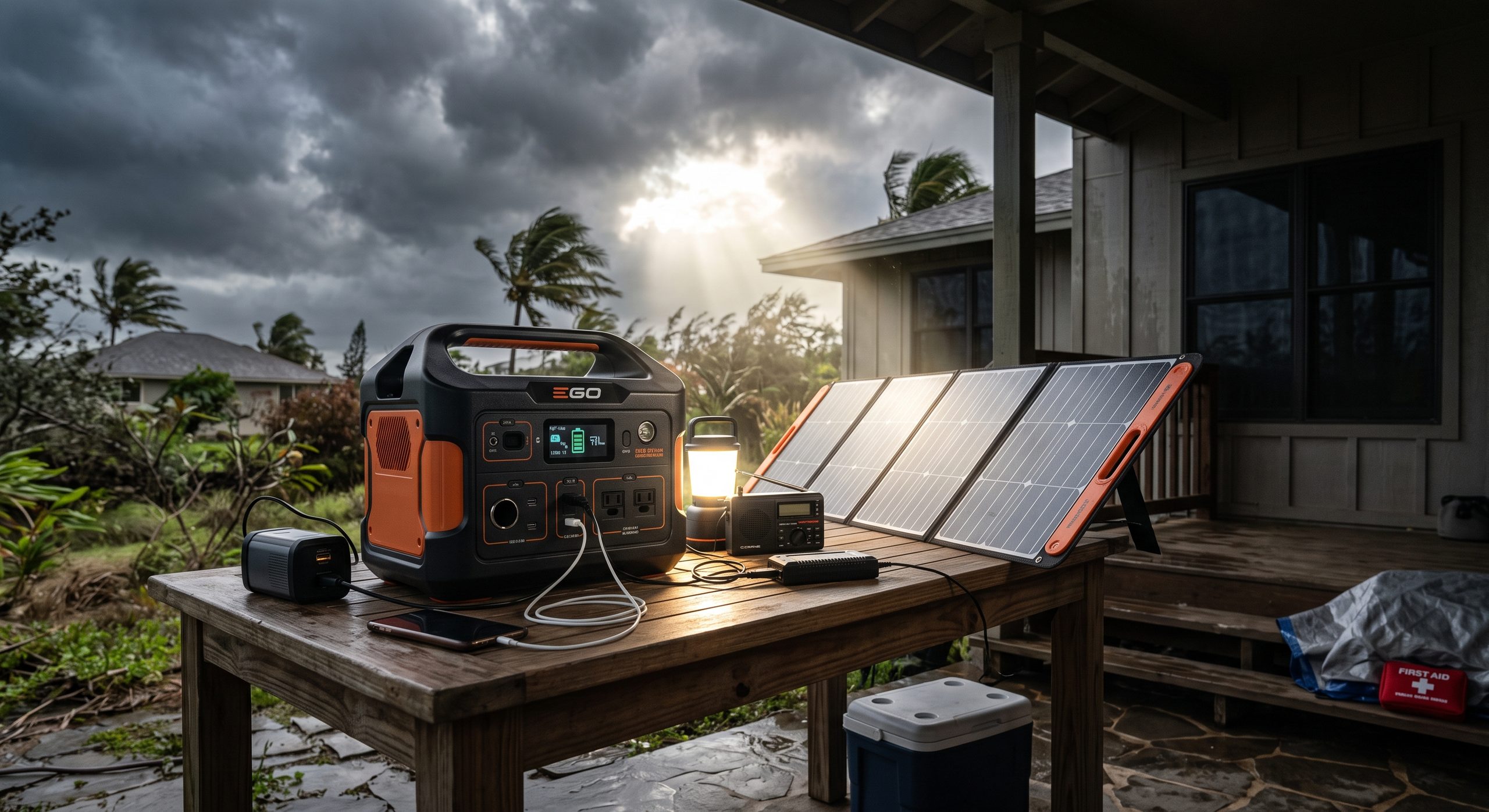
Hurricane season brings a specific kind of power problem: outages that can last anywhere from a few hours to over a week, often combined with days of advance warning that give you time to prepare — but also flooded roads, gas shortages, and downed power lines that make traditional generators harder to fuel and use safely. A solar generator (a portable power station paired with solar panels) solves this by recharging from sunlight when the grid, and often the gas station, is down. Here are the best options for hurricane preparedness in 2026.
Quick Answer: Our Top Picks
- Best Overall for Hurricane Prep: Bluetti AC500 + solar panel kit — massive capacity, modular, built for multi-day outages
- Best Value: Jackery Explorer 2000 v2 + SolarSaga panels — strong capacity-to-price ratio
- Most Portable (for evacuation): Anker Solix C800 — light enough to grab and go if you need to evacuate
- Best for Whole-Household Backup: EcoFlow Delta Pro Ultra + solar panels — highest ceiling for capacity and expansion
Why Solar Matters Specifically for Hurricanes
Unlike a winter storm outage, hurricane outages come with two extra complications: they can drag on for a week or more in the hardest-hit areas, and gas stations are often closed, flooded, or completely out of fuel — sometimes for days. A gas generator is only as useful as the fuel you can get to it. A solar generator sidesteps that problem entirely: as long as the sun comes out (which it usually does within a day or two after a hurricane passes), the system keeps recharging without needing a fuel run.
Top Solar Generators for Hurricane Season
1. Bluetti AC500 + B300S Battery Pack — Best Overall
This modular system starts at 3,072Wh per battery pack and can scale up to 18,432Wh by adding units, with solar input fast enough to fully recharge a pack in a few hours of strong sun. For households in hurricane-prone regions where outages regularly stretch past 3-4 days, this level of scalability is the difference between rationing power and running normally.
Best for: Homeowners in the Gulf Coast, Florida, or the Southeast who deal with hurricane season every year.
2. Jackery Explorer 2000 v2 + SolarSaga 200W Panels — Best Value
At 2,000Wh with 2,200W output, the Explorer 2000 v2 covers a refrigerator, lighting, medical devices, and device charging comfortably, and Jackery’s SolarSaga panels are known for reliable real-world charging speeds even under partly cloudy post-storm skies.
Best for: Households that want strong hurricane-season coverage without the cost of a fully modular system.
3. Anker Solix C800 — Most Portable (Evacuation-Friendly)
If there’s any chance you’ll need to evacuate, portability matters as much as capacity. The Solix C800 is compact and light enough to move quickly, while still offering 768Wh — enough to keep phones, a laptop, medical devices, and small lighting running at a shelter or hotel if the power there is also affected.
Best for: Residents in evacuation zones who need a «grab and go» option, not just a stay-at-home solution.
4. EcoFlow Delta Pro Ultra + Solar Panels — Best for Whole-Household Backup
For households that want to run close to normal during extended outages — fridge, some AC, lighting, and electronics — the Delta Pro Ultra’s expandable capacity (up to 90kWh with additional batteries) puts it closer to whole-home generator territory, but silent and fuel-free.
Best for: Larger households or those with medical equipment that absolutely cannot lose power during a multi-day hurricane outage.
How to Size Your System for Hurricane Season
Hurricane outages are less about peak wattage and more about sustained runtime over multiple days. When sizing a system:
- List your must-run items (fridge, medical devices, lighting, phone/laptop charging, Wi-Fi if available).
- Add up their running watts and multiply by expected hours of daily use.
- Choose a battery capacity that covers at least 1.5-2 days without recharging, since the first day or two after a hurricane often has heavy cloud cover before the sun fully returns.
- Pair with enough solar wattage to fully recharge your system in a single sunny day once skies clear — as a rough guide, 400W of solar panels can recharge a 2,000Wh system in roughly 5-7 hours of good sun.
Preparing Before the Storm
- Fully charge your power station before the storm arrives — don’t wait until the power is already out.
- Test your solar panel connections in advance, not for the first time during an actual outage.
- Keep panels and cables somewhere accessible but protected from wind and flooding, ready to deploy as soon as conditions are safe.
- Have a portable, lower-capacity backup unit as a secondary option in case you need to evacuate and leave the main system behind.
Bottom Line
For most households in hurricane-prone areas, a modular system like the Bluetti AC500 offers the best combination of capacity and scalability for outages that can stretch well past a few days. Households on a tighter budget get excellent real-world coverage from the Jackery Explorer 2000 v2, while anyone concerned about evacuation should keep a compact, portable unit like the Anker Solix C800 ready to go at a moment’s notice.