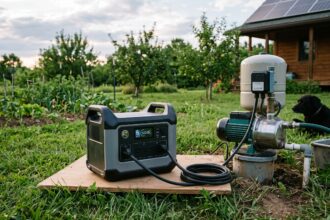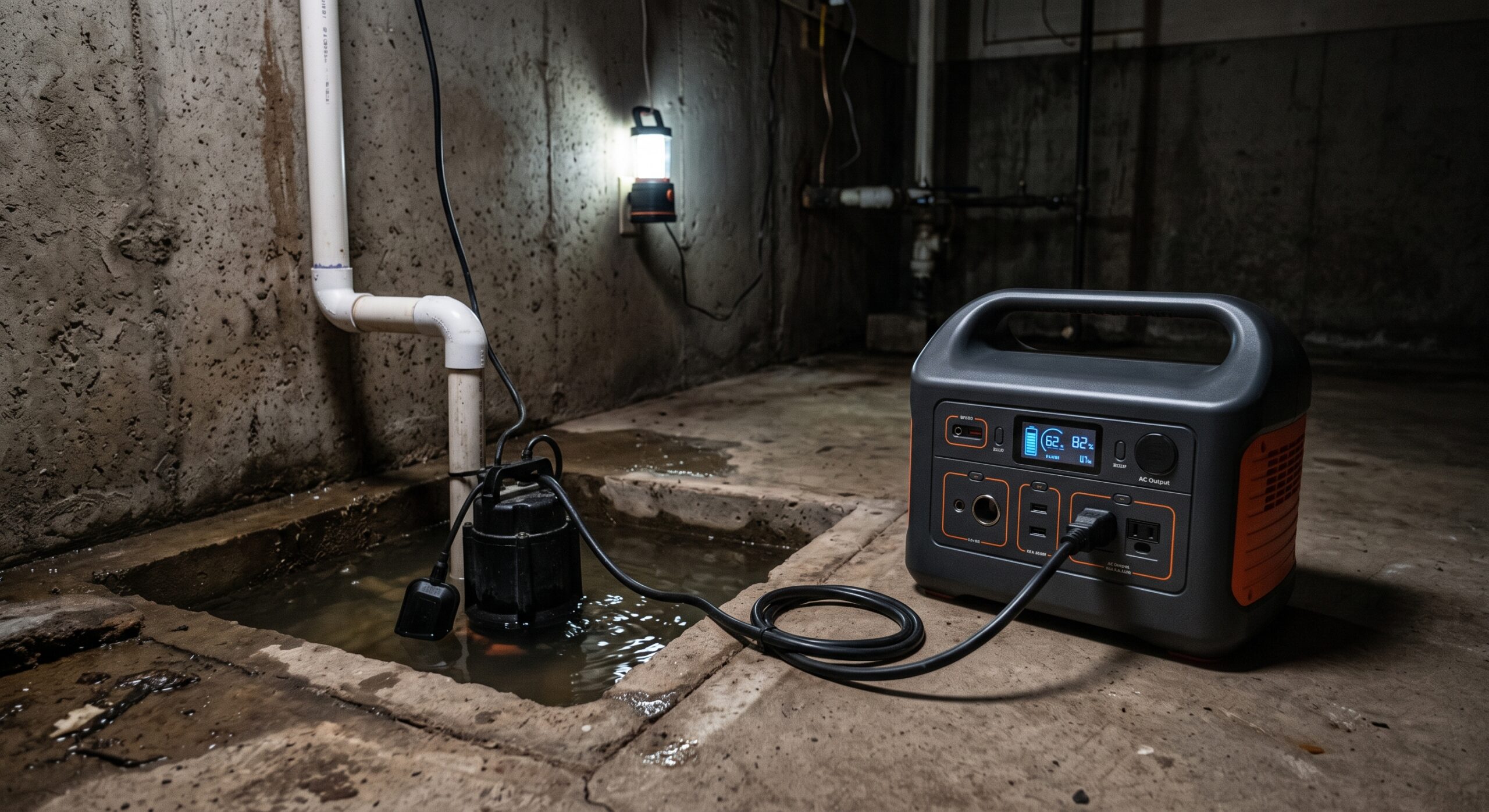
A sump pump failing during a power outage is one of the most common causes of home flooding — and it tends to happen at the worst possible time, since outages and heavy storms usually go hand in hand. Sump pumps also happen to be one of the more demanding appliances to power with a battery system, due to their high startup surge. This guide covers exactly what to look for and which power stations can realistically keep a sump pump running when it matters most.
Quick Answer: Our Top Picks
- Best Overall for Sump Pumps: Bluetti AC200L — high surge capacity with enough runtime for extended storms
- Best Value: EcoFlow Delta 2 — strong surge handling at a more accessible price point
- Best for Heavy-Duty Pumps: EcoFlow Delta Pro — handles large pumps with room to power other essentials simultaneously
- Best Compact Option (for smaller pumps): Jackery Explorer 1000 v2 — works for lighter-duty sump pumps in smaller basements
Why Sump Pumps Are Harder to Power Than Most Appliances
Sump pumps don’t run continuously — they cycle on when water reaches a certain level, then shut off once it’s pumped out. The problem is what happens in that first fraction of a second: the motor’s startup draw (surge wattage) can be 2-5 times higher than its running wattage, because the motor needs extra torque to start moving water from a stopped position.
| Sump Pump Type | Running Watts | Surge Watts |
|---|---|---|
| 1/3 HP pump | 800-1,000W | 1,300-2,000W |
| 1/2 HP pump | 1,000-1,300W | 2,000-2,800W |
| 3/4 HP pump | 1,300-1,600W | 2,800-3,500W |
| 1 HP pump | 1,600-2,000W | 3,500-4,500W |
This surge requirement is why many power stations that look sufficient on paper — based on their continuous wattage rating — actually fail to start a sump pump. The unit needs a surge rating that comfortably exceeds the pump’s startup draw, not just its running wattage.
How to Check Your Sump Pump’s Power Requirements
- Check the motor label on the pump itself, usually listing horsepower (HP) and sometimes amperage.
- Convert HP to a rough wattage estimate if only horsepower is listed: multiply HP by roughly 750-1,000W for a running estimate (motor efficiency varies).
- Assume surge wattage is 2-3x the running wattage unless the manufacturer specifies an exact figure — this is a safer assumption than guessing low.
- When in doubt, size up. An undersized power station that fails to start the pump during an actual flood risk is a far more costly mistake than paying for extra surge headroom.
Top Power Stations for Sump Pump Backup
1. Bluetti AC200L — Best Overall
With a continuous output of 2,400W and surge capability well above that, the AC200L comfortably starts and runs most 1/3 HP to 3/4 HP sump pumps, while its 2,048Wh capacity (expandable with additional battery packs) provides enough runtime to get through a multi-hour or overnight storm without running dry. This combination of surge headroom and expandable capacity makes it a strong all-around choice for basement flood protection.
Best for: Most residential sump pumps in homes with moderate to high flood risk during storms.
2. EcoFlow Delta 2 — Best Value
The Delta 2 offers 1,800W continuous output with an X-Boost mode that can push the surge handling higher for brief startup spikes, at a lower price point than premium competitors. For 1/3 HP and 1/2 HP pumps, this is often enough headroom without paying for capacity most households won’t fully use.
Best for: Homeowners with a standard 1/3-1/2 HP sump pump looking for solid performance without the premium price tag.
3. EcoFlow Delta Pro — Best for Heavy-Duty Pumps
Larger pumps (3/4 HP and above) or basements prone to severe, sustained flooding benefit from the Delta Pro’s 3,600W continuous output and 3,600Wh capacity (expandable up to 25kWh). This headroom also means the sump pump isn’t competing for the entire unit’s capacity — there’s room left over to run lighting, a refrigerator, or medical equipment simultaneously.
Best for: Homes with larger, high-HP sump pumps, or households that need the pump and other essentials running at the same time.
4. Jackery Explorer 1000 v2 — Best Compact Option
For smaller, lighter-duty sump pumps (typically 1/4-1/3 HP, common in homes with minor or occasional water intrusion rather than serious flood risk), the Explorer 1000 v2’s 1,000W continuous / 2,000W surge rating can be sufficient, though it leaves less margin than the higher-output options above.
Best for: Homes with smaller pumps and lower flood risk, where budget matters more than maximum headroom.
Sizing Your System for Real Storm Conditions
A sump pump’s power needs aren’t just about starting it once — during a serious storm, it may cycle on and off dozens of times per hour as groundwater rises. This means:
- Continuous output matters as much as surge, since the pump may be drawing power frequently, not just once.
- Capacity (Wh) determines how many hours you can sustain this cycling before the power station needs to recharge.
- Pairing with solar panels helps for storms lasting more than a day, though heavy rain and cloud cover — common during the exact storms that cause flooding — will slow solar recharging when you need it most, so battery capacity alone should be sized to get through the worst of the storm without relying on solar input.
Backup Options If You Don’t Have Enough Capacity
If your power station can’t sustain the sump pump for the full expected outage:
- Consider a battery backup sump pump system as a complementary (not replacement) solution — these are purpose-built dedicated batteries installed alongside the pump, designed specifically for this single job, and can be a more efficient use of budget if sump pump backup is your only real power concern.
- Prioritize the sump pump above all other loads during the outage — if capacity is limited, everything else (lighting, device charging, refrigerator) can wait or use a separate, smaller unit.
- Manually monitor water levels if capacity is genuinely insufficient, so you can intervene (a backup pump, a wet vac, calling for help) before minor water intrusion becomes serious damage.
Frequently Asked Questions
Can any portable power station run a sump pump? No — many lower-output units (under 1,000W continuous, or with surge ratings under 2,000W) will fail to start a sump pump even if the running wattage looks sufficient on paper, because they can’t handle the startup surge.
How long can a power station run a sump pump during a storm? It depends heavily on how often the pump cycles. A 2,000Wh power station might sustain a pump cycling moderately for 8-15 hours, but a pump running near-continuously during severe flooding will drain a battery much faster — this is a scenario where oversizing capacity is genuinely worth the extra cost.
Should I use a power station or a dedicated battery backup sump pump system? If sump pump protection is your only concern, a dedicated battery backup pump system (installed alongside your existing pump) is often more efficient and cost-effective. A portable power station makes more sense if you also want backup power for other household needs, since it serves multiple purposes rather than just one.
Bottom Line
Sump pumps are one of the more demanding appliances to back up with a portable power station, primarily because of their startup surge rather than their running wattage. The Bluetti AC200L offers the best balance of surge handling, capacity, and price for most residential setups, while the EcoFlow Delta Pro is worth the upgrade for larger pumps or households that need to run other essentials at the same time. Whatever unit you choose, confirming the actual surge rating of your specific pump — rather than assuming based on horsepower alone — is the detail that determines whether the system works when a real flood risk arrives.