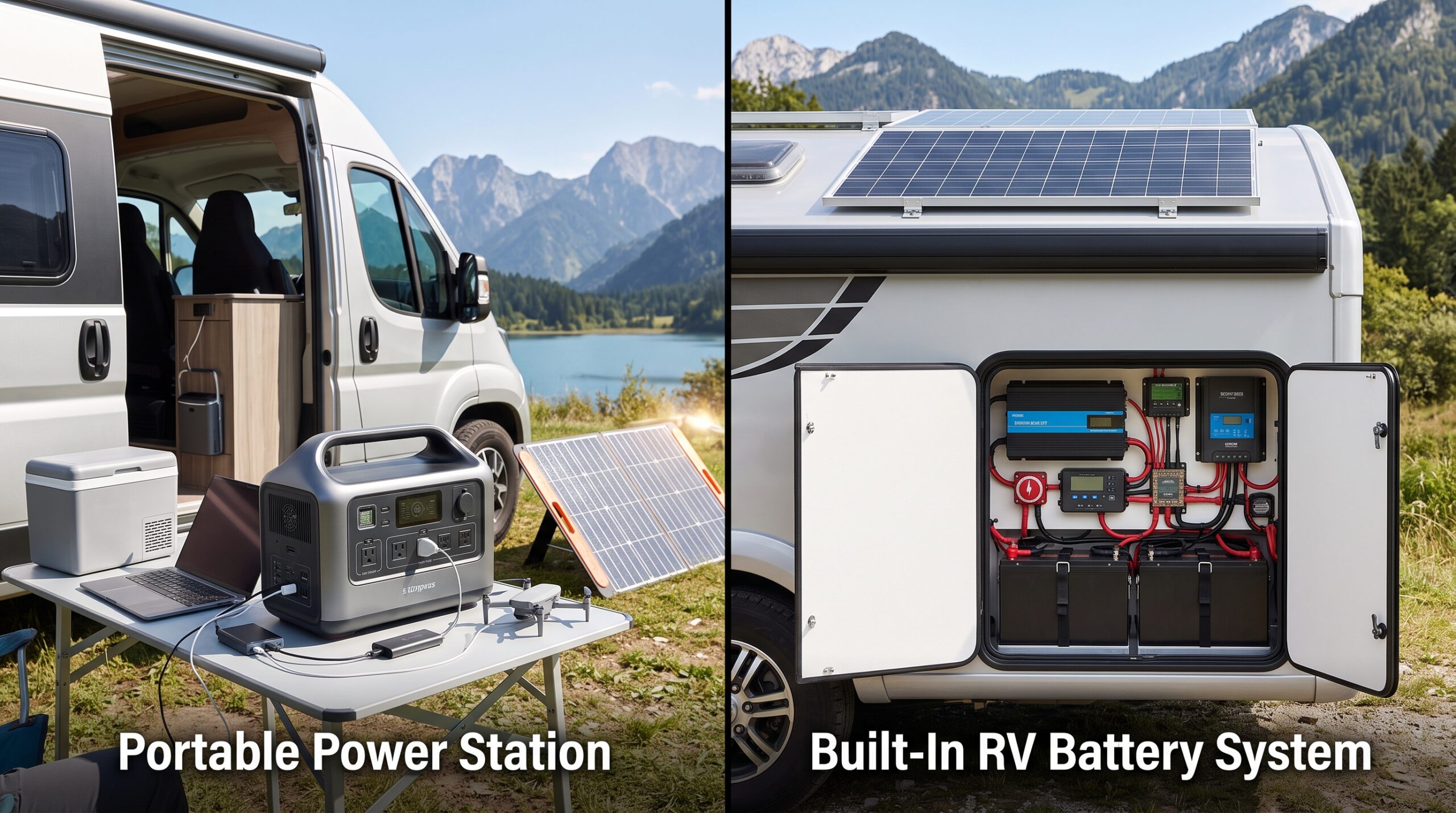
RV owners generally choose between two approaches to off-grid power: a portable power station, or a built-in (hardwired) battery system with a separate inverter, charge controller, and permanently installed battery bank. Both can power an RV off-grid, but they differ significantly in cost, flexibility, capacity ceiling, and installation complexity.
Quick Comparison
| Factor | Portable Power Station | Built-In Battery System |
| Installation | None plug and play | Requires professional or DIY electrical installation |
| Flexibility | Removable, upgradable, usable outside the RV | Permanently fixed to the vehicle |
| Capacity ceiling | Limited by unit size (typically up to ~25kWh with add-ons) | Can be scaled much higher with larger battery banks |
| Cost | Lower upfront cost | Higher upfront cost, but better value at large scale |
| Continuous output | Good for most needs, some models rival built-in systems | Can be designed for very high continuous loads |
| Best for | Smaller RVs, weekend use, budget-conscious owners | Full-time RVers, larger rigs, high daily power demands |
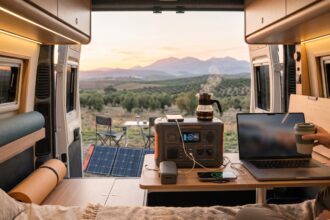
What a Portable Power Station Offers RV Owners
- No installation required, making it accessible to RV owners without electrical experience or the budget for professional installation.
- Portability it can be removed and used outside the RV (camping, home backup) or upgraded to a different unit without any rewiring.
- Lower upfront cost than an equivalent-capacity built-in system, since it doesn’t include installation labor or a separate inverter/charge controller purchase.
Limitations: Capacity is finite to what the unit itself holds (even expandable systems top out lower than a custom-built battery bank), and continuous output, while often sufficient, generally doesn’t match what a purpose-built high-capacity system can deliver.
What a Built-In Battery System Offers RV Owners
- Higher capacity ceiling – built-in systems can scale to tens of kilowatt-hours for full-time RVers with heavy daily power needs (multiple AC units, an induction cooktop, high-draw appliances).
- Integration with existing RV systems, including monitoring at the RV’s main electrical panel and compatibility with the RV’s existing wiring for lights and outlets.
- Often more cost-effective at large scale, since custom battery banks can be priced more efficiently per kWh than several portable units combined.
Limitations: Requires installation (professional installation often costs more than the equipment itself for complex systems), isn’t portable, and represents a larger upfront investment that’s harder to reverse or resell separately from the RV.
Which Type of RV Owner Fits Each Option?
- Weekend or occasional RVers with moderate power needs are usually well-served by a portable power station, avoiding the cost and complexity of a built-in system they wouldn’t fully utilize.
- Full-time RVers with heavy daily power needs – running AC units, cooking appliances, and extensive electronics often find that a built-in system pays for itself in capability and long-term cost-effectiveness.
- RV owners planning to upgrade or change vehicles may prefer a portable system’s flexibility, since it isn’t tied to a specific rig.
Can You Combine Both?
Yes some RV owners use a built-in system for baseline daily power needs and add a portable power station as supplemental capacity during high-demand periods, or as a backup if the built-in system needs maintenance. This hybrid approach adds cost but provides redundancy that a single system alone doesn’t.
Bottom Line
There’s no universal answer – it depends on how you use your RV. Portable power stations offer accessible, flexible power without installation complexity, well-suited to weekend and moderate-use RVing. Built-in systems offer a higher capacity ceiling and better long-term value for full-time RVers with heavy daily power demands, at the cost of a larger upfront investment and permanent installation. For many RV owners just starting to explore off-grid capability, a portable power station is also a lower-risk way to learn actual power usage patterns before committing to a larger, permanent system.